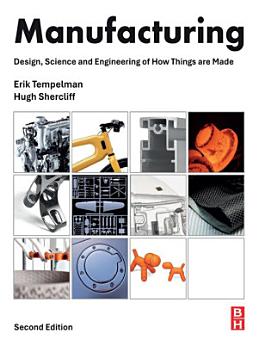
Manufacturing: Design, Science and Engineering of How Things are Made, Edition 2
Jul 2026 · Butterworth-Heinemann
Ebook
384
Pages
family_home
Eligible
info
About this ebook
Manufacturing: Design, Science and Engineering of How Things are Made, Second Edition presents a fresh view on the world of industrial production, in terms of both abstraction levels and trade-offs. The book invites its readers to distinguish between what is possible in principle for a certain process (as determined by physical law); what is possible in practice (the production method as determined by industrial state-of-the-art); and what is possible for a certain supplier (as determined by its production equipment). Specific processes considered include metal forging, extrusion, and casting; plastic injection molding and thermoforming; additive manufacturing; joining; recycling, and more. By tackling the field of manufacturing processes from this new angle, the book makes the most out of a reader's limited time. It gives the knowledge needed to not only create well-producible designs, but also to understand supplier needs in order to find the optimal compromise. Apart from improving design for production, this publication raises the standards of thinking about producibility. - Emphasises the strong links between product design, materials and their properties, and the choice and operation of manufacturing processes - Introduces the concept of a "manufacturing triangle" as a structured approach to considering the trade-offs between function, cost, and quality, for any conventional or emerging manufacturing process - Coverage of contemporary manufacturing technology – notably Additive Manufacturing, Industry 4.0, Remanufacturing and Recycling, and Design for Manufacture and Assembly (DFMA) - Includes a solutions manual and image bank for instructors
Manufacturing: Design, Science and Engineering of How Things are Made, Second Edition presents a fresh view on the world of industrial production, in terms of both abstraction levels and trade-offs. The book invites its readers to distinguish between what is possible in principle for a certain pr...
Discover more
About the author
Erik Tempelman is an Associate Professor of Industrial Design Engineering at Delft University of Technology (NL). A respectedteacher, he is well-known for his style and enthusiasm for education and for always connecting manufacturing process choicesto key design requirements and optimal cost/value ratios. He has published on a range of subjects, from automotive materialsselection to engineering education.Hugh Shercliff is an Emeritus Associate Professor in Materials in the Department of Engineering at the University of Cambridge(UK). His research experience spanned all classes of engineering materials, with an emphasis on process modelling applied tothe forming and joining of light alloys. He is co-author with Michael Ashby and David Cebon of Materials: Engineering, Science, Processing and Design, Fourth Edition (Butterworth-Heinemann, 2018), and Introduction to Materials Science and Engineering (Butterworth-Heinemann, 2023).
Erik Tempelman is an Associate Professor of Industrial Design Engineering at Delft University of Technology (NL). A respectedteacher, he is well-known for his style and enthusiasm for education and for always connecting manufacturing process choicesto key design requirements and optimal cost/valu...
Rate this ebook
Tell us what you think.
Reading information
Smartphones and tablets
Install the Google Play Books app for Android and iPad/iPhone. It syncs automatically with your account and allows you to read online or offline wherever you are.
Laptops and computers
You can listen to audiobooks purchased on Google Play using your computer's web browser.
eReaders and other devices
To read on e-ink devices like Kobo eReaders, you'll need to download a file and transfer it to your device. Follow the detailed Help Center instructions to transfer the files to supported eReaders.


