આ ઇ-પુસ્તક વિશે
વધુ શોધો
લેખક વિશે
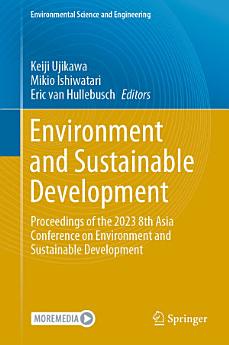
Keiji Ujikawa is a full professor in the Graduate School of International Social Sciences, Yokohama National University, Japan. He specializes in environmental economics, environmental policy studies, environmental valuation, and economic statistics. Professor Ujikawa's research interests include the indicators, decision making, and impact assessment of sustainable development. He is also interested in economic, social, and environmental effects of renewable energy (energy conservation) expansion. In 1996, he obtained his bachelor's degree in economics from the Faculty of Economics, Tohoku University, Sendai, Japan. In 1998 and 2002, respectively, he received his master's and Ph.D. degrees in economics from the Graduate School of Economics and Management, Tohoku University. He has published several books and a large number of academic articles, and he has served as the representative of research projects. In addition, he has supervised many master’s and Ph.D. students from abroad.
Mikio Ishiwatari is a senior advisor on disaster management and water resources management at the Japan International Cooperation Agency and a visiting professor at the Graduate School of Frontier Sciences, the University of Tokyo. He has been engaged in projects and research work on disaster risk reduction, climate change adaptation, and water issues. He led the formulation of the Japanese assistance policies of climate change adaptation and community-based disaster management.
At the World Bank he worked as a senior disaster risk management specialist and published Learning from Megadisaster: Lessons from the Great East Japan Earthquake. He worked in various positions at the Ministry of Land, Infrastructure, and Transport, Japan, for 17 years. He formulated and supervised national projects on flood risk management and highways in Iwami District as the director of the Hamada River and Road Office, and he was responsible for research and technology development as a senior deputy director for river technology and information. He also worked as an urban development specialist at the Asian Development Bank.
Dr. Ishiwatari was a member of the Committee on Building Resilience to Natural Disasters of the Japan Science Society, and he served as a member of the Advisory Council of Development Assistance in Climate Change Adaptation of the Ministry of Land Infrastructure, Transport and Tourism, Japan; the Steering Committee of Water and Climate Change of the Asia-Pacific Water Forum; and other committees of government organizations. He holds a Ph.D. in international studies and an M.Sc. in urban engineering from The University of Tokyo.
Eric D. van Hullebusch holds a Ph.D. in aquatic chemistry and microbiology, and he is a full professor in the biogeochemistry of engineered ecosystems at the Université de Paris and Institut de Physique du Globe de Paris (Paris, France). His main research interests include environmentaltechnologies and biogeochemistry with special focus on 1) study of metals and metalloids biogeochemistry in engineered ecosystems, 2) biohydrometallurgy of secondary resource streams, and 3) soil bioremediation. Within these research areas, he has published more than 250 papers in peer-reviewed scientific journals and is a co-author of more than 25 book chapters.