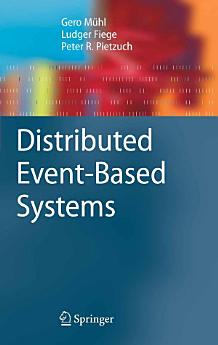
Distributed Event-Based Systems

· ·
· Springer Science & Business Media
eBook
388
Páginas

Información sobre este eBook

In today’s world, services and data are integrated in ever new constellations, requiring the easy, flexible and scalable integration of autonomous, heterogeneous components into complex systems at any time.

Event-based architectures inherently decouple system components. Event-based components are not designed to work with specific other components in a traditional request/reply mode, but separate communication from computation through asynchronous communication mechanisms via a dedicated notification service.

Mühl, Fiege, and Pietzuch provide the reader with an in-depth description of event-based systems. They cover the complete spectrum of topics, ranging from a treatment of local event matching and distributed event forwarding algorithms, through a more practical discussion of software engineering issues raised by the event-based style, to a presentation of state-of-the-art research topics in event-based systems, such as composite event detection and security. Their presentation gives researchers a comprehensive overview of the area and lots of hints for future research. In addition, they show the power of event-based architectures in modern system design, thus encouraging professionals to exploit this technique in next generation large-scale distributed applications like information dissemination, network monitoring, enterprise application integration, or mobile systems.


In today’s world, services and data are integrated in ever new constellations, requiring the easy, flexible and scalable integration of autonomous, heterogeneous components into complex systems at any time. Event-based architectures inherently decouple system components. Event-based components a...

Descubre más

Valorar este eBook

Danos tu opinión.

Información sobre cómo leer

Smartphones y tablets
Instala la aplicación Google Play Libros para Android y iPad/iPhone. Se sincroniza automáticamente con tu cuenta y te permite leer contenido online o sin conexión estés donde estés.
Ordenadores portátiles y de escritorio
Puedes usar el navegador web del ordenador para escuchar audiolibros que hayas comprado en Google Play.
eReaders y otros dispositivos
Para leer en dispositivos de tinta electrónica, como los lectores de libros electrónicos de Kobo, es necesario descargar un archivo y transferirlo al dispositivo. Sigue las instrucciones detalladas del Centro de Ayuda para transferir archivos a lectores de libros electrónicos compatibles.