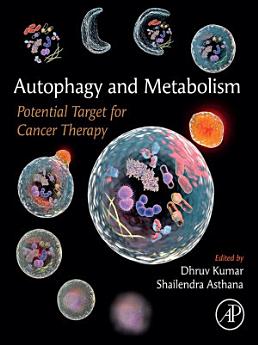
Autophagy and Metabolism: Potential Target for Cancer Therapy

·
· Elsevier
1 review
Ebook
362
Pages
Eligible

About this ebook

Autophagy and Metabolism: Potential Target for Cancer Therapy presents updates on autophagy in cancer metabolism and how it can be used to develop new, more efficient treatments. Written by experts in the field, the book presents recent research and explains how to translate it to the clinical setting. Sections discuss tumor cell metabolism and autophagy as therapeutic targets, autophagy regulation in cancer, signaling pathways in metabolic dysregulation in solid tumors, metabolic stress and cell death pathways, and the role of the tumor microenvironment. In addition, topics cover combined targeting autophagy, metabolism for cancer therapy, and the autophagy effect on immune cell metabolism. This will be a valuable resource for researchers, oncologists, graduate students, and members of the biomedical field who are interested in learning more about the interaction between autophagy and cancer metabolism. - Presents valuable and updated information on the mechanisms of autophagy in cancer metabolism - Discusses the various metabolic pathways linked with autophagy that can be a major target for chemotherapeutic strategies - Explains how autophagy supports tumor growth by activating metabolic phenotypes in cancer cells and the therapeutic interventions available to halt the process
Autophagy and Metabolism: Potential Target for Cancer Therapy presents updates on autophagy in cancer metabolism and how it can be used to develop new, more efficient treatments. Written by experts in the field, the book presents recent research and explains how to translate it to the clinical se...

Discover more

Ratings and reviews

1 review

About the author

Dr. Dhruv Kumar is a Senior Associate Professor at School of Health Sciences and Technology, UPES University, Dehradun, India and his current research is focused on autophagy, cancer cell metabolism, tumour microenvironment, exosomes, mutational heterogeneity, cancer prevention, drug designing, NGS and COVID-19. After completion of B.Sc. in Chemistry from Banaras Hindu University (BHU) and M.Sc. in Bioinformatics from University of Allahabad, India, he has completed his Ph.D. in Cellular, Molecular and Industrial Biology from the University of Bologna (UNIBO), under highly prestigious fellowship, Indo-Italian Government fellowship. After his Ph.D., he obtained Postdoctoral training at the University of Kansas Medical Center, USA. During his Postdoctoral training, he worked towards understanding the molecular mechanism(s) of autophagy regulation and apoptosis in cancer stem cells (prostate, pancreatic and breast), focusing on the metabolic cross-talk between the tumour microenvironment (cancer associated fibroblast (CAF)) and head and neck squamous cell carcinoma (HNSCC) via HGF/c-MET and bFGF/FGFR signalling pathways. He has also worked on structure based drug designing for several cancers, COVID-19, mutational heterogeneity in cancer. Currently, his lab is focusing on metabolic heterogeneity in solid tumours and structure based drug designing for cancer and COVID-19. He has published more than 100 research articles, reviews and book chapters in reputed journals.

Shailendra Asthana is a Senior Scientist at Translational Health Science and Technology Institute (THSTI), India. He has more than 20 years of research experience in drug discovery, autophagy, and bioinformatics. The goal of his research is to improve atomic level understanding of protein-ligand, protein-nucleic acid, protein-peptide and protein-protein interactions using computational models and tools. Using molecular modeling, molecular docking and physics-based methods such as molecular dynamics simulations, Dr. Asthana and his research group focus on how small molecules interact with proteins and thereby modulate their function.

Dr. Dhruv Kumar is a Senior Associate Professor at School of Health Sciences and Technology, UPES University, Dehradun, India and his current research is focused on autophagy, cancer cell metabolism, tumour microenvironment, exosomes, mutational heterogeneity, cancer prevention, drug designing, N...

Rate this ebook

Tell us what you think.

Reading information

Smartphones and tablets
Install the Google Play Books app for Android and iPad/iPhone. It syncs automatically with your account and allows you to read online or offline wherever you are.
Laptops and computers
You can listen to audiobooks purchased on Google Play using your computer's web browser.
eReaders and other devices
To read on e-ink devices like Kobo eReaders, you'll need to download a file and transfer it to your device. Follow the detailed Help Center instructions to transfer the files to supported eReaders.