Statistics is Easy! 2nd Edition: Edition 2
Jun 2022 · Springer Nature
Ebook
162
Pages
About this ebook
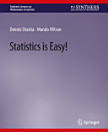
Statistics is the activity of inferring results about a population given a sample. Historically, statistics books assume an underlying distribution to the data (typically, the normal distribution) and derive results under that assumption. Unfortunately, in real life, one cannot normally be sure of the underlying distribution. For that reason, this book presents a distribution-independent approach to statistics based on a simple computational counting idea called resampling. This book explains the basic concepts of resampling, then system atically presents the standard statistical measures along with programs (in the language Python) to calculate them using resampling, and finally illustrates the use of the measures and programs in a case study. The text uses junior high school algebra and many examples to explain the concepts. Th e ideal reader has mastered at least elementary mathematics, likes to think procedurally, and is comfortable with computers. Table of Contents: The Basic Idea/ Pragmatic Considerations when Using Resampling / Terminology / The Essential Stats / Case Study: New Mexico's 2004 Presidential Ballots / References / Bias Corrected Confidence Intervals / Appendix B
Statistics is the activity of inferring results about a population given a sample. Historically, statistics books assume an underlying distribution to the data (typically, the normal distribution) and derive results under that assumption. Unfortunately, in real life, one cannot normally be sure o...
Discover more
About the author
Dennis Shasha is a Julius Silver Professor of computer science at the Courant Institute of New York University and an Associate Director of NYU Wireless. In addition to his long fascination with concurrent algorithms, he works on meta-algorithms for machine learning to achieve guaranteed correctness rates; with biologists on pattern discovery for network inference; with physicists and financial people on algorithms for time series; on database tuning; and tree and graph matching. Because he likes to type, he has written six books of puzzles about a mathematical detective named Dr. Ecco, a biography about great computer scientists, and a book about the future of computing. He has also written technical books about database tuning, biological pattern recognition, time series, DNA computing, resampling statistics, and causal inference in molecular networks. He has written the puzzle column for various publications including Scientific American, Dr. Dobb’s Journal, and currently the Communications of the ACM. He is a fellow of the ACM and an INRIA International Chair.
Dennis Shasha is a Julius Silver Professor of computer science at the Courant Institute of New York University and an Associate Director of NYU Wireless. In addition to his long fascination with concurrent algorithms, he works on meta-algorithms for machine learning to achieve guaranteed correctn...
Rate this ebook
Tell us what you think.
Reading information
Smartphones and tablets
Install the Google Play Books app for Android and iPad/iPhone. It syncs automatically with your account and allows you to read online or offline wherever you are.
Laptops and computers
You can listen to audiobooks purchased on Google Play using your computer's web browser.
eReaders and other devices
To read on e-ink devices like Kobo eReaders, you'll need to download a file and transfer it to your device. Follow the detailed Help Center instructions to transfer the files to supported eReaders.