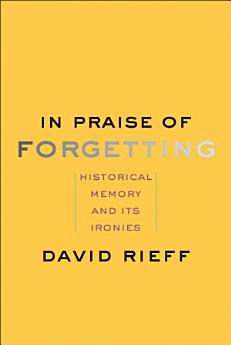
In Praise of Forgetting: Historical Memory and Its Ironies
May 2016 · Yale.ORIM
Ebook
158
Pages
family_home
Eligible
info
About this ebook
The conventional wisdom about historical memory is summed up in George Santayana's celebrated phrase, "Those who cannot remember the past are condemned to repeat it." Today, the consensus that it is moral to remember, immoral to forget, is nearly absolute. And yet is this right?
David Rieff, an independent writer who has reported on bloody conflicts in Africa, the Balkans, and Central Asia, insists that things are not so simple. He poses hard questions about whether remembrance ever truly has, or indeed ever could, "inoculate" the present against repeating the crimes of the past. He argues that rubbing raw historical wounds—whether self-inflicted or imposed by outside forces—neither remedies injustice nor confers reconciliation. If he is right, then historical memory is not a moral imperative but rather a moral option—sometimes called for, sometimes not. Collective remembrance can be toxic. Sometimes, Rieff concludes, it may be more moral to forget.
Ranging widely across some of the defining conflicts of modern times—the Irish Troubles and the Easter Uprising of 1916, the white settlement of Australia, the American Civil War, the Balkan wars, the Holocaust, and 9/11—Rieff presents a pellucid examination of the uses and abuses of historical memory. His contentious, brilliant, and elegant essay is an indispensable work of moral philosophy.
The conventional wisdom about historical memory is summed up in George Santayana's celebrated phrase, "Those who cannot remember the past are condemned to repeat it." Today, the consensus that it is moral to remember, immoral to forget, is nearly absolute. And yet is this right?
David Rieff, an ...
About the author
David Rieff is the author of many books, including , most recently, The Reproach of Hunger: Food, Justice, and Money in the 21st Century. He lives in New York City.
David Rieff is the author of many books, including , most recently, The Reproach of Hunger: Food, Justice, and Money in the 21st Century. He lives in New York City.
Rate this ebook
Tell us what you think.
Reading information
Smartphones and tablets
Install the Google Play Books app for Android and iPad/iPhone. It syncs automatically with your account and allows you to read online or offline wherever you are.
Laptops and computers
You can listen to audiobooks purchased on Google Play using your computer's web browser.
eReaders and other devices
To read on e-ink devices like Kobo eReaders, you'll need to download a file and transfer it to your device. Follow the detailed Help Center instructions to transfer the files to supported eReaders.