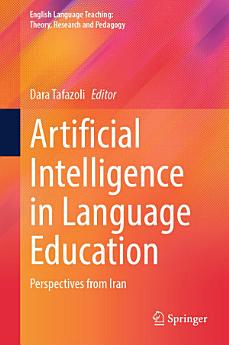
Artificial Intelligence in Language Education: Perspectives from Iran

· Springer Nature
Ebook
277
Pages

About this ebook

Artificial Intelligence in Language Education: Perspectives from Iran explores how AI is used, interpreted, and debated in English language education within one of the world’s most digitally constrained EFL contexts. The volume brings together conceptual, empirical, classroom-based, and review-driven studies to examine AI-mediated language education amid sanctions, platform restrictions, internet filtering, uneven connectivity, assessment pressures, and institutional uncertainty. Rather than treating AI as either a universal solution or an inherent threat, the book asks under what conditions it becomes pedagogically meaningful, equitable, and responsible. The chapters address critical AI literacy, AI in teacher education, peer coaching, teacher reflection and well-being, writing feedback, speaking and pronunciation development, linguistic norms, and emerging research trends in Iranian EFL. The volume presents AI not as a neutral tool, but as a force shaping feedback, learner agency, teacher labour, assessment, creativity, and educational access. It highlights both the promise and the risks of AI, including inequity, dependency, bias, privacy concerns, and uneven access.

By placing Iran at the centre of analysis, this book offers a context-sensitive account of AI in language education with relevance far beyond a single national setting. It is valuable to researchers, teacher educators, postgraduate students, policymakers, and ELT professionals across applied linguistics, TESOL, CALL, educational technology, and AI ethics.

Artificial Intelligence in Language Education: Perspectives from Iran explores how AI is used, interpreted, and debated in English language education within one of the world’s most digitally constrained EFL contexts. The volume brings together conceptual, empirical, classroom-based, and review-dr...

Discover more

About the author

Dara Tafazoli (PhD, University of Córdoba, Spain) is a researcher and educator specialising in the integration of emerging technologies, especially artificial intelligence (AI), immersive environments, and digital innovations, into language teaching and higher education. He currently serves as Research Lead in AI in Education at the School of Education, La Trobe University, Australia. His research and teaching interests include computer-assisted language learning (CALL), teacher education, and cultural issues in language education, and his work is driven by a deep commitment to equity, access, and inclusion, ensuring that technology-enhanced education benefits learners from under-represented and resource-constrained contexts.

His recent co-edited volumes are Computer-assisted language learning in the Global South (Routledge, 2024) and Handbook of CALL teacher education and professional development (Springer, 2023). Dara serves as the Book Series Editor of Digital Teacher Education Futures and the Editor-in-Chief of The Palgrave encyclopedia of computer-assisted language learning.

His scholarship consistently focuses not only on what technology can do, but how it can serve social good, learner empowerment, and educator agency. He is committed to collaborative, impact-driven research that leads to practical models and frameworks for educators, learners, and policy-makers alike.
Dara Tafazoli (PhD, University of Córdoba, Spain) is a researcher and educator specialising in the integration of emerging technologies, especially artificial intelligence (AI), immersive environments, and digital innovations, into language teaching and higher education. He currently serves as Re...

Rate this ebook

Tell us what you think.

Reading information

Smartphones and tablets
Install the Google Play Books app for Android and iPad/iPhone. It syncs automatically with your account and allows you to read online or offline wherever you are.
Laptops and computers
You can listen to audiobooks purchased on Google Play using your computer's web browser.
eReaders and other devices
To read on e-ink devices like Kobo eReaders, you'll need to download a file and transfer it to your device. Follow the detailed Help Center instructions to transfer the files to supported eReaders.