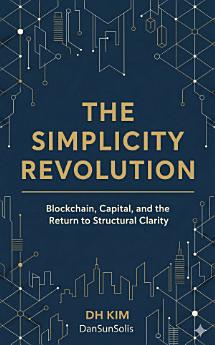
About this ebook
Stop reconciling the past and start building the future: The end of the hidden tax on global trust.
The world is drowning in paper trails.
Every time you swipe a card, buy a stock, or verify your identity, a massive, hidden machinery hums into life. It’s a chaotic web of spreadsheets, custodians, clearinghouses, and intermediaries—all frantically checking their notes to see if they agree with one another.
We call this "business as usual." It is actually a structural crisis.
The Simplicity Revolution reveals that our modern institutions are built on a fundamental flaw: fragmented truth. Banks, governments, and markets all maintain their own separate ledgers, forcing us to waste billions of dollars and years of human potential just to "reconcile" what we already know to be true.
The Shift from Friction to Flow
This isn't a book about the hype of cryptocurrency; it’s about the architecture of trust. We are moving toward a world of shared digital ledgers—a new infrastructure where we no longer maintain parallel versions of reality.
Instead of constantly rebuilding trust through middle-men, trust is becoming structural.
What’s at Stake?
Drawing on the history of financial evolution and the trajectory of the internet, this book maps out how shared ledgers will reshape:
Capital Markets: Moving from days-long settlements to instant finality.
Digital Identity: Reclaiming ownership of who you are.
Global Commerce: Eliminating the "reconciliation tax" on every border crossing.
Institutional Governance: How we coordinate at a global scale without collapsing under our own weight.
A Map for the Next Era
The Simplicity Revolution is not a technical manual. It is a conceptual lighthouse for investors, policymakers, and builders. It provides a clear framework for understanding the most significant structural transformation of our time.
The next phase of global coordination will not be won by the most complex system. It will be won by the simplest.
The future will be built on shared truth. Discover how.
Discover more
Ratings and reviews

- Flag inappropriate
- Show review history
About the author
Dohyung “DH” Kim
Dohyung "DH" Kim is a global financial infrastructure executive, fintech pioneer, and author with over two decades of experience across capital markets, financial regulation, and natural resources development. He is the CEO of Finhaven Group, a leading financial infrastructure company that achieved a historic milestone in 2020 as the first platform in Canada to receive regulatory authorization as a digital securities dealer, marketplace, and clearing agency.
A recognized expert in the institutionalization of digital assets, Kim is the architect of Finhaven Chain, a public-blockchain project designed to provide global institutional-grade infrastructure for alternative investments. His extensive leadership background includes serving as Chairman and CEO of NMC Resource Corporation and Executive Vice President of Dongwon Group, where he led major international mining and strategic restructuring initiatives.
Beyond his executive roles, Kim is deeply involved in financial policy and academia. He serves as a Member of the Business & Economic Leadership Council of the Legislative Assembly of British Columbia and was a member of the British Columbia Securities Commission (BCSC) Fintech Advisory Committee. He has also served as a Policy Advisor to the Ministry of Trade, Industry and Energy of the Republic of Korea and has held academic appointments at Korea University.
Kim holds a Master of International Affairs from Columbia University and a Bachelor of Arts in International Politics (Honors) from Lewis & Clark College. A frequent keynote speaker at global economic and fintech conferences, he writes extensively on the intersection of blockchain, capital markets, and structural clarity.