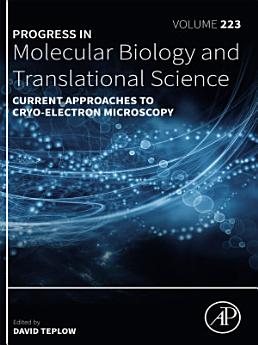
Current Approaches to Cryo-electron Microscopy

· Progress in Molecular Biology and Translational Science Ibhuku elingu-223 · Academic Press
I-Ebook
300
Amakhasi
Kufanelekile

Mayelana nale ebook

Current Approaches to Cryo-electron Microscopy, Volume 223 provides a comprehensive overview of the field, tracing its evolution from early structural studies to modern pipelines powered by deep-learning algorithms for helical reconstruction. The book addresses the persistent bottleneck of sample preparation, detailing the physical challenges of fibril clumping and interfacial adsorption, alongside emerging solutions to these problems. Chapters in this new release include Advancing biological understanding of the poxvirus scaffold through breakthroughs in cryo-electron microscopy, Pursuing the physics of cryoEM image formation, AI Tools for Cryo-EM: Protein Particle Picking, Density Map Enhancement, and Atomic Model Building, and much more.Additional chapters cover Cryo-EM of Amyloid Fibrils: Advances, Challenges, and Translational Applications, Computational Approaches for Protein Complex Modeling for Intermediate Resolution Cryo-EM Maps, Calcium-sensing receptor, involved in the oral perception of the kokumi substances, Insights into the Structure and Diversity of the Bacterial Flagellum from cryo-EM studies, Overview and future potential in structural studies of bacteriophages by cryo-electron microscopy, and more. - Reviews cryo-EM yields near-atomic structures that advance neurodegenerative/metabolic disease understanding and enable drug design - Provides information on deep-learning AI accelerates structure determination through image processing, map enhancement, and model building - Assesses key challenges and opportunities including sample prep bottlenecks, polymorphism, and using high-res maps to design inhibitors that disaggregate fibrils
Current Approaches to Cryo-electron Microscopy, Volume 223 provides a comprehensive overview of the field, tracing its evolution from early structural studies to modern pipelines powered by deep-learning algorithms for helical reconstruction. The book addresses the persistent bottleneck of sample...

Thola okuningi

Mayelana nomlobi

David B. Teplow, Ph.D., is a Professor of Neurology, Emeritus, at UCLA and an internationally recognized leader in efforts to understand and treat Alzheimer's disease. Dr. Teplow's group has used a multi-disciplinary approach to determine how neurotoxic peptides, such as the amyloid β-protein (Alzheimer's disease) and α-synuclein (Parkinson’s disease), form neurotoxic structures that kill neurons and to develop the means to block these processes. Dr. Teplow received undergraduate training at UC Berkeley; a Ph.D. from the University of Washington; and was a postdoctoral scholar at Caltech. Before coming to UCLA, Dr. Teplow was a faculty member in the Department of Neurology, Harvard Medical School. Dr. Teplow has published >250 peer-reviewed articles, books and book chapters, and commentaries, in addition to serving on numerous national and international scientific advisory boards. Dr. Teplow was a founding editor of the Journal of Molecular Neuroscience and Current Chemical Biology, He is Editor-in-Chief of the Elsevier serial Progress in Molecular Biology and Translational Science and is Associate Editor-in-Chief of the American Journal of Neurodegenerative Disease.

David B. Teplow, Ph.D., is a Professor of Neurology, Emeritus, at UCLA and an internationally recognized leader in efforts to understand and treat Alzheimer's disease. Dr. Teplow's group has used a multi-disciplinary approach to determine how neurotoxic peptides, such as the amyloid β-protein (Al...

Nikeza le ebook isilinganiso

Sitshele ukuthi ucabangani.

Ulwazi lokufunda

Amasmathifoni namathebulethi
Faka uhlelo lokusebenza lwe-Google Play Amabhuku lwe-Android ne-iPad/iPhone. Livunyelaniswa ngokuzenzakalela ne-akhawunti yakho liphinde likuvumele ukuthi ufunde uxhunywe ku-inthanethi noma ungaxhunyiwe noma ngabe ukuphi.
Amakhompyutha aphathekayo namakhompyutha
Ungalalela ama-audiobook athengwe ku-Google Play usebenzisa isiphequluli sewebhu sekhompuyutha yakho.
Ama-eReaders namanye amadivayisi
Ukuze ufunde kumadivayisi e-e-ink afana ne-Kobo eReaders, uzodinga ukudawuniloda ifayela futhi ulidlulisele kudivayisi yakho. Landela imiyalelo Yesikhungo Sosizo eningiliziwe ukuze udlulise amafayela kuma-eReader asekelwayo.