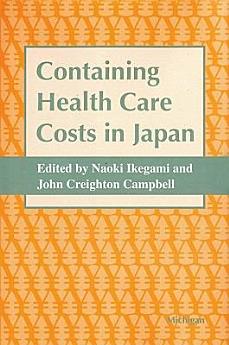
Containing Health Care Costs in Japan
eBook 정보
Offered here is an analysis of the key issues of cost-containment by specialists followed by reactions from some of America's best-known experts on health care delivery and finance. Topics include the macro-and microeconomics of health care, technology and costs, institutions and costs, attitudinal and behavioral aspects, and the politics of health care.
This collection provides an authoritative study of successful cost-containment in the Japanese health care system---a chronicle of success that is neither a statistical illusion nor a result of sociocultural factors. Detailed here is information on the key mechanism of cost constraint: a fee schedule that covers virtually all medical services and rewards inexpensive services while making expensive services unprofitable. This system has resulted in the provision of quality health care to the entire population at roughly half the cost of American health care. Is it a single-payer system? Would the United States have to introduce a dramatically altered health care structure to benefit from the Japanese experience? No. Japan relies mainly on fee-for-service medicine financed by multiple insurers---a system familiar to Americans and one from which many lessons may be learned.
Based on conferences held in Washington, D.C., and Izu, Japan, this volume collects original chapters on the overall cost structure, how the negotiated mandatory fee schedule works, specific mechanisms for cost control, the politics of health care financing, and the impact of cost cutting on quality, among other topics. These pathbreaking studies will be a significant resource for policymakers and scholars interested in comparative health care systems as well as those interested in health care reform in the United States.
콘텐츠 둘러보기
저자 정보
John Creighton Campbell is professor of political science at the University of Michigan. He is the author of How Policies Change: The Japanese Government and the Aging Society.