Complex Networks

· EOLSS Publications
电子书
362
页
符合条件

关于此电子书

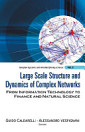
The field of complex network exploded since the 1990s, the number of publications in a variety of different areas has grown exponentially and practically, and every discipline started to recognize the presence of these mathematical structures in its area of research. Actually almost any system from the nowadays traditional example of the Internet to complex patterns of metabolic reactions can be analyzed through the graph theory. In its simplest and non rigorous definition a graph is a mathematical object consisting of a set of elements (vertices) and a series of links between these vertices (edges). This is of course a very general description, and as any mathematical abstraction, the idea is to discard many of the particular properties of the phenomenon studied. Nevertheless, this modeling is remarkably accurate for a variety of situations. Vertices can be persons related by friendship or acquaintances relations. Vertices can be proteins connected with one another if they interact in the cell. Networks have always existed in Nature of course, but it is fair to say that given the present technological explosion, they became more and more important. Starting from the Internet the web of connections between computers we started to link and share our documents through web applications and we start to get connected with a number of persons larger than usual. It is this revolution in our daily habit that made natural thinking of networks in science and research. Once this has been realized it became natural to see the cell as a network of molecular events from chemical reactions to gene expressions. The point is to establish if this new perspective can help researchers in finding new results and by understanding the development of these phenomena and possibly control their evolution. We believe that this is the case and in the following we shall provide the evidence of that. Together with applications there are of course true scientific questions attached to network theory. Consider the various ways in which the edges are distributed among the vertices: even by keeping the number of edges and vertices constant we have many different patterns possible. Interestingly some features used to describe these shapes are not related to the particular example considered, but instead they are universal. That is to say they can be found in almost any network around.


In this book, we introduce the subject of complex networks and we present the structure of the associated topics that range from social science to biology and finance. We start by considering the mathematical foundations of networks and we then move to an overview of the various applications
The field of complex network exploded since the 1990s, the number of publications in a variety of different areas has grown exponentially and practically, and every discipline started to recognize the presence of these mathematical structures in its area of research. Actually almost any system fr...

作者简介

Guido Caldarelli is currently Associate Professor in the Institute of Complex Systems in the Department of Physics of the University of Rome "Sapienza" Italy. The institute is part National Research Council (CNR) of Italy.


He got his degree in physics in the Department of Physics of the same University in 1992 working with L. Pietronero and A. Vespignani. He then moved to SISSA/ISAS in Trieste where he got the PhD in Statistical Physics in 1996 working on Self-Organized Criticality with A. Maritan. He has been postdoc in the Department of Physics in the University of Manchester with A. McKane and in TCM Group in the University of Cambridge with R. Ball. During his scientific activity in Rome he has also been visiting professor in the École Normale Supérieure in Paris, and in the Department of Physics of the University of Barcelona.


After the studies on fractal growth and self-organized criticality he moved his research on the analysis of scale-free networks. On this topic he published a textbook and he coordinated a European Project (http://www.cosinproject.org).
Guido Caldarelli is currently Associate Professor in the Institute of Complex Systems in the Department of Physics of the University of Rome "Sapienza" Italy. The institute is part National Research Council (CNR) of Italy. He got his degree in physics in the Department of Physics of the same Un...

为此电子书评分

欢迎向我们提供反馈意见。

如何阅读

智能手机和平板电脑
只要安装 Android 和 iPad/iPhone 版的 Google Play 图书应用,不仅应用内容会自动与您的账号同步,还能让您随时随地在线或离线阅览图书。
笔记本电脑和台式机
您可以使用计算机的网络浏览器聆听您在 Google Play 购买的有声读物。
电子阅读器和其他设备
如果要在 Kobo 电子阅读器等电子墨水屏设备上阅读,您需要下载一个文件,并将其传输到相应设备上。若要将文件传输到受支持的电子阅读器上,请按帮助中心内的详细说明操作。