Complex Networks

· EOLSS Publications
Libër elektronik
362
Faqe
Kualifikohet

Rreth këtij libri elektronik

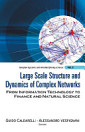
The field of complex network exploded since the 1990s, the number of publications in a variety of different areas has grown exponentially and practically, and every discipline started to recognize the presence of these mathematical structures in its area of research. Actually almost any system from the nowadays traditional example of the Internet to complex patterns of metabolic reactions can be analyzed through the graph theory. In its simplest and non rigorous definition a graph is a mathematical object consisting of a set of elements (vertices) and a series of links between these vertices (edges). This is of course a very general description, and as any mathematical abstraction, the idea is to discard many of the particular properties of the phenomenon studied. Nevertheless, this modeling is remarkably accurate for a variety of situations. Vertices can be persons related by friendship or acquaintances relations. Vertices can be proteins connected with one another if they interact in the cell. Networks have always existed in Nature of course, but it is fair to say that given the present technological explosion, they became more and more important. Starting from the Internet the web of connections between computers we started to link and share our documents through web applications and we start to get connected with a number of persons larger than usual. It is this revolution in our daily habit that made natural thinking of networks in science and research. Once this has been realized it became natural to see the cell as a network of molecular events from chemical reactions to gene expressions. The point is to establish if this new perspective can help researchers in finding new results and by understanding the development of these phenomena and possibly control their evolution. We believe that this is the case and in the following we shall provide the evidence of that. Together with applications there are of course true scientific questions attached to network theory. Consider the various ways in which the edges are distributed among the vertices: even by keeping the number of edges and vertices constant we have many different patterns possible. Interestingly some features used to describe these shapes are not related to the particular example considered, but instead they are universal. That is to say they can be found in almost any network around.


In this book, we introduce the subject of complex networks and we present the structure of the associated topics that range from social science to biology and finance. We start by considering the mathematical foundations of networks and we then move to an overview of the various applications
The field of complex network exploded since the 1990s, the number of publications in a variety of different areas has grown exponentially and practically, and every discipline started to recognize the presence of these mathematical structures in its area of research. Actually almost any system fr...

Rreth autorit

Guido Caldarelli is currently Associate Professor in the Institute of Complex Systems in the Department of Physics of the University of Rome "Sapienza" Italy. The institute is part National Research Council (CNR) of Italy.


He got his degree in physics in the Department of Physics of the same University in 1992 working with L. Pietronero and A. Vespignani. He then moved to SISSA/ISAS in Trieste where he got the PhD in Statistical Physics in 1996 working on Self-Organized Criticality with A. Maritan. He has been postdoc in the Department of Physics in the University of Manchester with A. McKane and in TCM Group in the University of Cambridge with R. Ball. During his scientific activity in Rome he has also been visiting professor in the École Normale Supérieure in Paris, and in the Department of Physics of the University of Barcelona.


After the studies on fractal growth and self-organized criticality he moved his research on the analysis of scale-free networks. On this topic he published a textbook and he coordinated a European Project (http://www.cosinproject.org).
Guido Caldarelli is currently Associate Professor in the Institute of Complex Systems in the Department of Physics of the University of Rome "Sapienza" Italy. The institute is part National Research Council (CNR) of Italy. He got his degree in physics in the Department of Physics of the same Un...

Vlerëso këtë libër elektronik

Na trego se çfarë mendon.

Informacione për leximin

Telefona inteligjentë dhe tabletë
Instalo aplikacionin "Librat e Google Play" për Android dhe iPad/iPhone. Ai sinkronizohet automatikisht me llogarinë tënde dhe të lejon të lexosh online dhe offline kudo që të ndodhesh.
Laptopë dhe kompjuterë
Mund të dëgjosh librat me audio të blerë në Google Play duke përdorur shfletuesin e uebit të kompjuterit.
Lexuesit elektronikë dhe pajisjet e tjera
Për të lexuar në pajisjet me bojë elektronike si p.sh. lexuesit e librave elektronikë Kobo, do të të duhet të shkarkosh një skedar dhe ta transferosh atë te pajisja jote. Ndiq udhëzimet e detajuara në Qendrën e ndihmës për të transferuar skedarët te lexuesit e mbështetur të librave elektronikë.