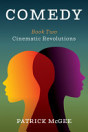
Comedy, Book Two: Cinematic Revolutions
2022年6月 · Wipf and Stock Publishers
电子书
186
页
工具
info
family_home
符合条件
info
关于此电子书
Comedy is a philosophical poem in the form of waking dream, inspired by Dante and William Blake. In book two, Cinematic Revolutions, the narrator, having passed through a cinema screen at the end of book one, arrives in the middle of a World War I field of dying men. An indescribable human figure appears who warns that these cinematic images are not real but projections of the cinematic mind with its power of empathy. Assuming different shapes and identities, this generic being becomes the narrator's guide. Through a series of dialogues and encounters, cinema and the visual culture it generates are identified with a cultural revolution--the nonviolent revolution--that surpasses the violent revolutions of the twentieth century. This view is articulated through encounters with Russian revolutionary Trotsky, twelve modernist writers and the philosopher Wittgenstein, Hitchcock, three dictators (Hitler, Stalin, Mao), a cinematic Jesus Christ, Holocaust historian Raul Hilberg, Martin Luther King, Malcolm X, and James Baldwin. Interspersed among these encounters are cinematic visions from directors like Eisenstein, Chaplin, and others. From Paris to Memphis, passing through Pasolini's black and white desert in Gospel according to Saint Matthew, descending into the dark underworld of Fritz Lang's Metropolis, rising into a Hollywood heaven of the forties, and standing on top of the Empire State Building with King Kong, cinematic images channel revolutionary desires and the necessity of nonviolence.
Comedy is a philosophical poem in the form of waking dream, inspired by Dante and William Blake. In book two, Cinematic Revolutions, the narrator, having passed through a cinema screen at the end of book one, arrives in the middle of a World War I field of dying men. An indescribable human figure...
作者简介
Patrick McGee is emeritus professor from Louisiana State University, where he taught modern literature, film, and critical theory. He is the author of ten previous books, including Archival Resurrections, book one of Comedy, and Political Monsters and Democratic Imagination: Spinoza, Blake, Hugo, Joyce. He currently lives in Seattle.
Patrick McGee is emeritus professor from Louisiana State University, where he taught modern literature, film, and critical theory. He is the author of ten previous books, including Archival Resurrections, book one of Comedy, and Political Monsters and Democratic Imagination: Spinoza, Blake, Hugo,...
为此电子书评分
欢迎向我们提供反馈意见。
如何阅读
智能手机和平板电脑
笔记本电脑和台式机
您可以使用计算机的网络浏览器聆听您在 Google Play 购买的有声读物。
电子阅读器和其他设备
如果要在 Kobo 电子阅读器等电子墨水屏设备上阅读,您需要下载一个文件,并将其传输到相应设备上。若要将文件传输到受支持的电子阅读器上,请按帮助中心内的详细说明操作。