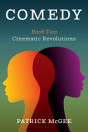
Comedy, Book Two: Cinematic Revolutions
juny del 2022 · Wipf and Stock Publishers
Llibre electrònic
186
Pàgines
Eines
info
family_home
Apte
info
Sobre aquest llibre
Comedy is a philosophical poem in the form of waking dream, inspired by Dante and William Blake. In book two, Cinematic Revolutions, the narrator, having passed through a cinema screen at the end of book one, arrives in the middle of a World War I field of dying men. An indescribable human figure appears who warns that these cinematic images are not real but projections of the cinematic mind with its power of empathy. Assuming different shapes and identities, this generic being becomes the narrator's guide. Through a series of dialogues and encounters, cinema and the visual culture it generates are identified with a cultural revolution--the nonviolent revolution--that surpasses the violent revolutions of the twentieth century. This view is articulated through encounters with Russian revolutionary Trotsky, twelve modernist writers and the philosopher Wittgenstein, Hitchcock, three dictators (Hitler, Stalin, Mao), a cinematic Jesus Christ, Holocaust historian Raul Hilberg, Martin Luther King, Malcolm X, and James Baldwin. Interspersed among these encounters are cinematic visions from directors like Eisenstein, Chaplin, and others. From Paris to Memphis, passing through Pasolini's black and white desert in Gospel according to Saint Matthew, descending into the dark underworld of Fritz Lang's Metropolis, rising into a Hollywood heaven of the forties, and standing on top of the Empire State Building with King Kong, cinematic images channel revolutionary desires and the necessity of nonviolence.
Comedy is a philosophical poem in the form of waking dream, inspired by Dante and William Blake. In book two, Cinematic Revolutions, the narrator, having passed through a cinema screen at the end of book one, arrives in the middle of a World War I field of dying men. An indescribable human figure...
Sobre l'autor
Patrick McGee is emeritus professor from Louisiana State University, where he taught modern literature, film, and critical theory. He is the author of ten previous books, including Archival Resurrections, book one of Comedy, and Political Monsters and Democratic Imagination: Spinoza, Blake, Hugo, Joyce. He currently lives in Seattle.
Patrick McGee is emeritus professor from Louisiana State University, where he taught modern literature, film, and critical theory. He is the author of ten previous books, including Archival Resurrections, book one of Comedy, and Political Monsters and Democratic Imagination: Spinoza, Blake, Hugo,...
Puntua aquest llibre electrònic
Dona'ns la teva opinió.
Informació de lectura
Telèfons intel·ligents i tauletes
Instal·la l'aplicació Google Play Llibres per a Android i per a iPad i iPhone. Aquesta aplicació se sincronitza automàticament amb el compte i et permet llegir llibres en línia o sense connexió a qualsevol lloc.
Ordinadors portàtils i ordinadors de taula
Pots escoltar els audiollibres que has comprat a Google Play amb el navegador web de l'ordinador.
Lectors de llibres electrònics i altres dispositius
Per llegir en dispositius de tinta electrònica, com ara lectors de llibres electrònics Kobo, hauràs de baixar un fitxer i transferir-lo al dispositiu. Segueix les instruccions detallades del Centre d'ajuda per transferir els fitxers a lectors de llibres electrònics compatibles.