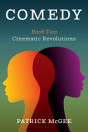
Comedy, Book Two: Cinematic Revolutions
Jun. 2022 · Wipf and Stock Publishers
E-boek
186
Bladsye
Nutsgoed
info
family_home
Geskik
info
Meer oor hierdie e-boek
Comedy is a philosophical poem in the form of waking dream, inspired by Dante and William Blake. In book two, Cinematic Revolutions, the narrator, having passed through a cinema screen at the end of book one, arrives in the middle of a World War I field of dying men. An indescribable human figure appears who warns that these cinematic images are not real but projections of the cinematic mind with its power of empathy. Assuming different shapes and identities, this generic being becomes the narrator's guide. Through a series of dialogues and encounters, cinema and the visual culture it generates are identified with a cultural revolution--the nonviolent revolution--that surpasses the violent revolutions of the twentieth century. This view is articulated through encounters with Russian revolutionary Trotsky, twelve modernist writers and the philosopher Wittgenstein, Hitchcock, three dictators (Hitler, Stalin, Mao), a cinematic Jesus Christ, Holocaust historian Raul Hilberg, Martin Luther King, Malcolm X, and James Baldwin. Interspersed among these encounters are cinematic visions from directors like Eisenstein, Chaplin, and others. From Paris to Memphis, passing through Pasolini's black and white desert in Gospel according to Saint Matthew, descending into the dark underworld of Fritz Lang's Metropolis, rising into a Hollywood heaven of the forties, and standing on top of the Empire State Building with King Kong, cinematic images channel revolutionary desires and the necessity of nonviolence.
Comedy is a philosophical poem in the form of waking dream, inspired by Dante and William Blake. In book two, Cinematic Revolutions, the narrator, having passed through a cinema screen at the end of book one, arrives in the middle of a World War I field of dying men. An indescribable human figure...
Meer oor die skrywer
Patrick McGee is emeritus professor from Louisiana State University, where he taught modern literature, film, and critical theory. He is the author of ten previous books, including Archival Resurrections, book one of Comedy, and Political Monsters and Democratic Imagination: Spinoza, Blake, Hugo, Joyce. He currently lives in Seattle.
Patrick McGee is emeritus professor from Louisiana State University, where he taught modern literature, film, and critical theory. He is the author of ten previous books, including Archival Resurrections, book one of Comedy, and Political Monsters and Democratic Imagination: Spinoza, Blake, Hugo,...
Gradeer hierdie e-boek
Sê vir ons wat jy dink.
Lees inligting
Slimfone en tablette
Installeer die Google Play Boeke-app vir Android en iPad/iPhone. Dit sinkroniseer outomaties met jou rekening en maak dit vir jou moontlik om aanlyn of vanlyn te lees waar jy ook al is.
Skootrekenaars en rekenaars
Jy kan jou rekenaar se webblaaier gebruik om na oudioboeke wat jy op Google Play gekoop het, te luister.
E-lesers en ander toestelle
Om op e-inktoestelle soos Kobo-e-lesers te lees, moet jy ’n lêer aflaai en dit na jou toestel toe oordra. Volg die gedetailleerde hulpsentrumaanwysings om die lêers na ondersteunde e-lesers toe oor te dra.