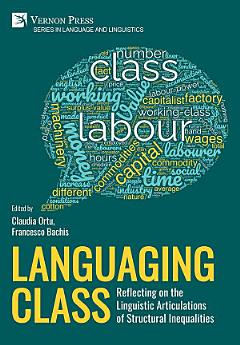
Languaging Class: Reflecting on the Linguistic Articulations of Structural Inequalities

· · · · · ·
· Vernon Press
Ebook
192
Pages
Eligible

About this ebook

This volume explores the issue of social class from the point of view of its linguistic articulations. Indeed, as Machin and Richardson (2008) stated, "discourses may be variously approached as (often simultaneously) reflecting class structures, as a site of class inequalities, as expressive of class identities or class consciousness and/or as a constituent part of more performative class action." Some of the contributions that make up the volume were presented at a conference held at Cagliari University, Italy, in 2017 and responded to the call for analyses on the role of language in reflecting, maintaining, enacting, and inculcating ideas on social class in literary and non-literary texts and discourses in any cultural or linguistic setting. This volume aspires to encourage scholars in disciplines and academic fields that have shied away from reflections on structural inequalities in favor of studies on ethnic, gender, and cultural identities in the last decades to take back on board the concept of social class and to engage with it in a novel way. The variety of approaches - ranging from the more traditional sociolinguistic one, anthropology, to literary and discourse studies - and cultural settings - with case studies coming from 3 continents - represented in the chapters show that social class is a productive and illuminating concept for trying to (re)make sense of social reproduction and change.
This volume explores the issue of social class from the point of view of its linguistic articulations. Indeed, as Machin and Richardson (2008) stated, "discourses may be variously approached as (often simultaneously) reflecting class structures, as a site of class inequalities, as expressive of c...

Discover more

About the author

Claudia Ortu (Ph.D., University of Naples, Federico II) is a researcher in English Language and Translation at the University of Cagliari in Italy. She worked as a post-doctoral researcher at the University of Johannesburg for two years. She has studied British and South African political and neoliberal discourses, with a special focus on the discourse of neoliberal governments on trade unions. She is the author of the monograph 'Industrial Relations and Conservative Governments in the Eighties' (Arcane, 2012) and of various articles, among which: "At the Intersection of Class and Race: Languaging and Picturing Diversity in Post-Apartheid South Africa" (2015); "Trade Unions in South Africa and the Discourse of the Neoliberal State" (2015); and "Saps-Speak: The Language of the South African Police in the Postapartheid Era" (2019). Her main research interests are Critical Discourse Analysis, Systemic Functional Linguistics, multimodality, and the language of Neoliberalism and trade unions. Francesco Bachis (Ph.D., University of Siena) is Senior Research Fellow (RTD-B) in Social and Cultural Anthropology at the University of Cagliari, Italy. Currently, he is carrying on a research project about heritage-making and memories in Southwest Sardinia and fieldwork on the use of the social network TikTok by the so-called "second generation" of migrants in Italy. Among his publications: "Transnational Migration in Sardinia. Reflecting on Belongings and Symbolic Boundaries" (2016); "Mobilities, Boundaries, Religions: Remarks on comparative research in the Mediterranean" (2014); and 'Sull'orlo del pregiudizio. Razzismo e islamofobia in una prospettiva antropologica' (2018). His main research interests are Symbolic Boundaries in Transnational Migrations, Racism and Islamophobia in Europe, Visual Ethnography, and Mining Anthropology.
Claudia Ortu (Ph.D., University of Naples, Federico II) is a researcher in English Language and Translation at the University of Cagliari in Italy. She worked as a post-doctoral researcher at the University of Johannesburg for two years. She has studied British and South African political and neo...

Rate this ebook

Tell us what you think.

Reading information

Smartphones and tablets
Install the Google Play Books app for Android and iPad/iPhone. It syncs automatically with your account and allows you to read online or offline wherever you are.
Laptops and computers
You can listen to audiobooks purchased on Google Play using your computer's web browser.
eReaders and other devices
To read on e-ink devices like Kobo eReaders, you'll need to download a file and transfer it to your device. Follow the detailed Help Center instructions to transfer the files to supported eReaders.