About this ebook
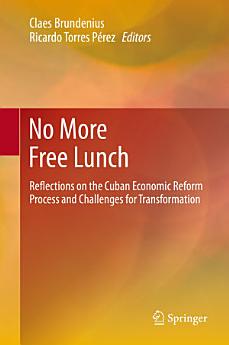
The result of these field visits and a subsequent workshop involving contributions from Cuban as well as non-Cuban scholars, this volume showcases unprecedented new insights into the process and prospects for reform along many dimensions, including foreign direct investment, import substitution, entrepreneurship and business creation, science and technology development, and fiscal policies. The resulting analysis, in a comparative perspective, provides a framework for future research as well as for business practice and policymaking.
Discover more
About the author
Claes Brundenius is Honorary Professor at the Research Policy Institute (RPI), Lund University, Sweden. He holds a PhD in Economic History from Lund University. Before joining the staff at RPI he was attached to the OECD Directorate for Scientific Affairs in Paris. He has been a Guest Professor at Pittsburgh University (1984) and Smith College (1987), USA. Between 1997 and 2003 he was Senior Researcher at the Centre for Development Research in Copenhagen. His main interest is research and policy studies on the role and impact of Science, Technology and Innovation policies and strategies in developing countries. His current work has focused on policy analysis of technological change and knowledge based development in developing and transition economies, notably in Latin America and the Caribbean, East Asia, and Southern Africa (SADC). His latest book (co-editor with Bo Göransson) is Universities in Transition – The Changing Role and Challenges for Academic Institutions (Springer, New York, 2011).
Ricardo Torres Pérez holds a PhD in Economic Sciences from the University of Havana. He is currently associate professor with the Centro de Estudios de la Economía Cubana (CEEC) at the University of Havana. He was a government scholar at Hitotsubashi University in Japan (2007-2009) and visiting researcher at Harvard University and the Ohio State University (2012). He has published in the Harvard International Review and has chapters in several books, including “Cincuenta años de la economía cubana” (Editorial Ciencias Sociales, Havana, 2010) and “Cuba: hacia una estrategia de desarrollo para los inicios del siglo XXI" (Editorial Universidad Javeriana de Cali, 2012).