About this ebook
Discover more
About the author
Christopher Hill discovered his fascination with attention and cognitive performance during an unlikely detour. After completing an undergraduate degree in mechanical engineering, he spent two years working in a high-volume manufacturing plant where he watched skilled operators produce flawless work in chaotic environments while equally skilled workers produced mediocre output in quiet rooms. The difference was not talent or tools — it was the ability to direct and sustain attention under pressure. That observation redirected his career entirely.
He returned to academic study, earning a master's degree in cognitive psychology from the University of Edinburgh, where his thesis examined the effects of environmental complexity on sustained attention spans. His research drew on both laboratory experiments and field observations in professional settings, bridging the gap between controlled cognitive science and the messy reality of modern work. He later completed a postgraduate certificate in organizational behavior from the London Business School, adding a systems-level perspective to his individual-focused research.
Over the past fourteen years, Hill has worked as a cognitive performance consultant for technology firms, financial institutions, and creative agencies across Europe and North America. He has designed focus-recovery programs for teams ranging from six-person startups to thousand-person engineering departments. His workshops and one-on-one coaching engagements have reached over twelve thousand professionals, and his articles on attention architecture and deep work practices have been published in several industry journals and professional development platforms.
Outside of his consulting practice, Hill is an avid long-distance cyclist and a devoted reader of twentieth-century poetry. He lives in a converted stone cottage in the Scottish Borders with his partner and two rescue greyhounds, where he maintains a strict no-phone policy in the house before noon — a personal rule that grew directly out of his research on morning cognitive peaks. He credits his best ideas to long rides on quiet country roads and to the discipline of reading slowly and without interruption.
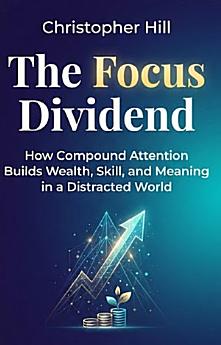
His working philosophy is straightforward: attention is not a resource to be managed but an investment to be compounded. He argues that most productivity advice treats focus as a finite daily budget to be spent wisely, when in reality, sustained attention generates returns that grow exponentially over time — sharper thinking today makes tomorrow's thinking faster, deeper, and more creative. The professionals who understand this distinction, he believes, are the ones who produce work that endures.
Hill continues to develop new frameworks for measuring cognitive returns and refining the DEEP Method through ongoing collaboration with neuroscience researchers at University College London. His current project explores how attention compounding interacts with sleep architecture and circadian rhythms, with the goal of helping professionals align their most demanding cognitive work with their biological peak windows.