About this ebook
Although Aristotle’s contribution to biology has long been recognized, there are many philosophers and historians of science who still hold that he was the great delayer of natural science, calling him the man who held up the Scientific Revolution by two thousand years. They argue that Aristotle never considered the nature of matter as such or the changes that perceptible objects undergo simply as physical objects; he only thought about the many different, specific natures found in perceptible objects.
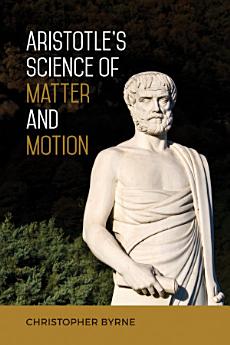
Aristotle’s Science of Matter and Motion’s focus is on refuting this misconception, arguing that Aristotle actually offered a systematic account of matter, motion, and the basic causal powers found in all physical objects. Author, Christopher Byrne sheds lights on Aristotle’s account of matter, revealing how Aristotle maintained that all perceptible objects are ultimately made from physical matter of one kind or another, accounting for their basic common features. For Aristotle, then, matter matters a great deal.
Although Aristotle’s contribution to biology has long been recognized, there are many philosophers and historians of science who still hold that he was the great delayer of natural science, calling him the man who held up the Scientific Revolution by two thousand years. They argue that Aristotle ...
About the author
Christopher Byrne is an associate professor in the Department of Philosophy at St. Francis Xavier University.
Christopher Byrne is an associate professor in the Department of Philosophy at St. Francis Xavier University.
Rate this ebook
Tell us what you think.
Reading information
Smartphones and tablets
Install the Google Play Books app for Android and iPad/iPhone. It syncs automatically with your account and allows you to read online or offline wherever you are.
Laptops and computers
You can listen to audiobooks purchased on Google Play using your computer's web browser.
eReaders and other devices
To read on e-ink devices like Kobo eReaders, you'll need to download a file and transfer it to your device. Follow the detailed Help Center instructions to transfer the files to supported eReaders.