About this ebook
A vital guide to building the platforms and systems that bring deep learning models to production.
In Designing Deep Learning Systems you will learn how to:
Deep learning systems are the components and infrastructure essential to supporting a deep learning model in a production environment. Written especially for software engineers with minimal knowledge of deep learning’s design requirements, Designing Deep Learning Systems is full of hands-on examples that will help you transfer your software development skills to creating these deep learning platforms. You’ll learn how to build automated and scalable services for core tasks like dataset management, model training/serving, and hyperparameter tuning. This book is the perfect way to step into an exciting—and lucrative—career as a deep learning engineer.
About the technology
To be practically usable, a deep learning model must be built into a software platform. As a software engineer, you need a deep understanding of deep learning to create such a system. Th is book gives you that depth.
About the book
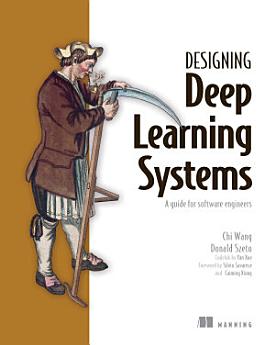
Designing Deep Learning Systems: A software engineer's guide teaches you everything you need to design and implement a production-ready deep learning platform. First, it presents the big picture of a deep learning system from the developer’s perspective, including its major components and how they are connected. Then, it carefully guides you through the engineering methods you’ll need to build your own maintainable, efficient, and scalable deep learning platforms.
What's inside
About the reader
For software developers and engineering-minded data scientists. Examples in Java and Python.
About the author
Chi Wang is a principal software developer in the Salesforce Einstein group. Donald Szeto was the co-founder and CTO of PredictionIO.
Table of Contents
1 An introduction to deep learning systems
2 Dataset management service
3 Model training service
4 Distributed training
5 Hyperparameter optimization service
6 Model serving design
7 Model serving in practice
8 Metadata and artifact store
9 Workflow orchestration
10 Path to production
In Designing Deep Learning Systems you will learn how to:
- Transfer your software development skills to deep learning systems
- Recognize and solve common engineering challenges for deep learning systems
- Understand the deep learning development cycle
- Automate training for models in TensorFlow and PyTorch
- Optimize dataset management, training, model serving and hyperparameter tuning
- Pick the right open-source project for your platform
Deep learning systems are the components and infrastructure essential to supporting a deep learning model in a production environment. Written especially for software engineers with minimal knowledge of deep learning’s design requirements, Designing Deep Learning Systems is full of hands-on examples that will help you transfer your software development skills to creating these deep learning platforms. You’ll learn how to build automated and scalable services for core tasks like dataset management, model training/serving, and hyperparameter tuning. This book is the perfect way to step into an exciting—and lucrative—career as a deep learning engineer.
About the technology
To be practically usable, a deep learning model must be built into a software platform. As a software engineer, you need a deep understanding of deep learning to create such a system. Th is book gives you that depth.
About the book
Designing Deep Learning Systems: A software engineer's guide teaches you everything you need to design and implement a production-ready deep learning platform. First, it presents the big picture of a deep learning system from the developer’s perspective, including its major components and how they are connected. Then, it carefully guides you through the engineering methods you’ll need to build your own maintainable, efficient, and scalable deep learning platforms.
What's inside
- The deep learning development cycle
- Automate training in TensorFlow and PyTorch
- Dataset management, model serving, and hyperparameter tuning
- A hands-on deep learning lab
About the reader
For software developers and engineering-minded data scientists. Examples in Java and Python.
About the author
Chi Wang is a principal software developer in the Salesforce Einstein group. Donald Szeto was the co-founder and CTO of PredictionIO.
Table of Contents
1 An introduction to deep learning systems
2 Dataset management service
3 Model training service
4 Distributed training
5 Hyperparameter optimization service
6 Model serving design
7 Model serving in practice
8 Metadata and artifact store
9 Workflow orchestration
10 Path to production
A vital guide to building the platforms and systems that bring deep learning models to production.
In Designing Deep Learning Systems you will learn how to:
Transfer your software development skills to deep learning systems
Recognize and solve common engineering challenges for deep learning syst...
Discover more
Ratings and reviews
1 review
About the author
Chi Wang is a principal software developer in the Salesforce Einstein group where he builds the deep learning platform for millions of Salesforce customers. Previously, he worked at Microsoft Bing and Azure on building large-scale distributed systems. Chi has filed six patents, mostly in deep learning systems.
Donald Szeto was the co-founder and CTO of PredictionIO, a startup that aimed to help democratize and accelerate the adoption of machine learning. PredictionIO was acquired by Salesforce, where he continued his work on machine learning and deep learning systems. Donald is currently investing in, advising, and mentoring technology startups.
Donald Szeto was the co-founder and CTO of PredictionIO, a startup that aimed to help democratize and accelerate the adoption of machine learning. PredictionIO was acquired by Salesforce, where he continued his work on machine learning and deep learning systems. Donald is currently investing in, advising, and mentoring technology startups.
Chi Wang is a principal software developer in the Salesforce Einstein group where he builds the deep learning platform for millions of Salesforce customers. Previously, he worked at Microsoft Bing and Azure on building large-scale distributed systems. Chi has filed six patents, mostly in deep lea...
Rate this ebook
Tell us what you think.
Reading information
Smartphones and tablets
Install the Google Play Books app for Android and iPad/iPhone. It syncs automatically with your account and allows you to read online or offline wherever you are.
Laptops and computers
You can listen to audiobooks purchased on Google Play using your computer's web browser.
eReaders and other devices
To read on e-ink devices like Kobo eReaders, you'll need to download a file and transfer it to your device. Follow the detailed Help Center instructions to transfer the files to supported eReaders.