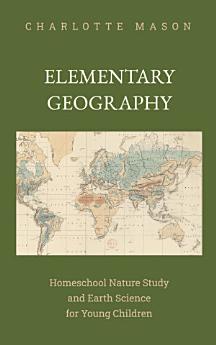
Elementary Geography: Homeschool Nature Study and Earth Science for Young Children
About this ebook
Long before modern educational theory embraced outdoor learning, pioneering educator Charlotte Mason revolutionized the Victorian schoolroom with her belief that children learn best through direct, living encounters with the world around them. First published in 1881 as The Forty Shires and later adapted into this introductory volume, the text was crafted to awaken a child’s natural sense of place. Moving beyond dry memorization and rote definitions, Mason invites young minds to look outside, observe the heavens, and understand the ground beneath their feet.
Through conversational narrative and thoughtful inquiry, the book guides readers from immediate, tactile concepts to broader global horizons. Beginning with the cardinal points, the nature of shadows, and the simple art of map-making, Mason gradually expands outward to explain the motion of the Earth, the behavior of rivers and tides, and the diverse contours of continents and oceans. Every lesson is designed to cultivate the habit of observation, turning everyday walks into rich geographic investigations.
Beneath its gentle tone lies a profound educational philosophy centered on respect for the child’s intellect. Mason understood that geography is not merely the study of borders and topography, but a vital lens through which young learners understand humanity’s home. By weaving scientific concepts with engaging descriptions and verse, she ensures that knowledge is not passively received, but actively assimilated through the imagination.
Today, Elementary Geography remains an enduring favorite among home educators and parents seeking a gentler, more intuitive approach to the natural sciences. Timeless, accessible, and deeply inspiring, it serves as the definitive starting point for anyone wishing to introduce a child to the beauty and order of the wider world.
Discover more
Ratings and reviews
About the author
Charlotte Mason was a pioneering British educator whose philosophy transformed early learning through an emphasis on direct observation, living ideas, and deep respect for the child’s intellect. Her gentle, nature-centered approach to instruction has left an enduring legacy, continuing to inspire parents, teachers, and home educators worldwide.