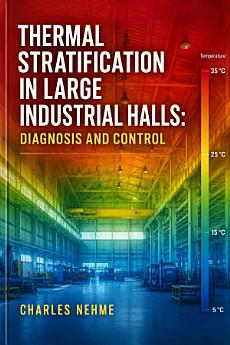
Thermal Stratification in Large Industrial Halls: Diagsis and Control

Charles Nehme
Ebook
93
Pages
Tools
Eligible

About this ebook

Thermal stratification is one of those silent inefficiencies in large industrial buildings that rarely gets the attention it deserves—until energy bills rise, comfort complaints increase, or process conditions drift out of control. In warehouses, factories, aircraft hangars, and other high-bay structures, it is not uncommon to find temperature differences of 8°C, 12°C, or even more between floor level and ceiling level. This vertical temperature layering is not just a comfort issue; it is an energy loss mechanism, a control challenge, and in many cases, a design oversight.

The challenge with stratification is that it is both simple and complex. Simple in physics—warm air rises, cold air sinks. Complex in reality—because building geometry, HVAC system design, operational schedules, internal heat gains, and even door openings all interact to create unpredictable airflow behavior. Many systems are installed with the expectation that air will “mix itself,” yet large volumes rarely behave in that idealized way.

This book was written to bridge the gap between theory and field reality. It focuses not only on understanding why stratification occurs, but also on how to diagnose it accurately, quantify its impact, and most importantly, control it in a practical and economically viable way. The goal is to move beyond generic HVAC solutions and toward performance-driven design and operation strategies tailored for large-volume industrial environments.

Rather than treating stratification as a secondary effect, this work positions it as a primary design and operational parameter—one that directly influences energy consumption, system sizing, occupant comfort, and process reliability.


Thermal stratification is one of those silent inefficiencies in large industrial buildings that rarely gets the attention it deserves—until energy bills rise, comfort complaints increase, or process conditions drift out of control. In warehouses, factories, aircraft hangars, and other high-bay st...

Discover more

About the author

https://bit.ly/m/HVAC
https://bit.ly/m/HVAC

Rate this ebook

Tell us what you think.

Reading information

Smartphones and tablets
Install the Google Play Books app for Android and iPad/iPhone. It syncs automatically with your account and allows you to read online or offline wherever you are.
Laptops and computers
You can listen to audiobooks purchased on Google Play using your computer's web browser.
eReaders and other devices
To read on e-ink devices like Kobo eReaders, you'll need to download a file and transfer it to your device. Follow the detailed Help Center instructions to transfer the files to supported eReaders.