About this ebook
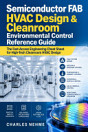
In such environments, the role of MEP engineering shifts fundamentally. Air is no longer ventilation—it becomes a transport medium for particles and chemical species that must be rigorously controlled. Pressure is no longer comfort balance—it becomes a directional barrier that defines contamination pathways. Temperature and humidity are not comfort parameters—they are stability constraints that influence electrostatic behavior, chemical reaction rates, and lithography precision. Electrical systems are not simply power delivery networks—they are continuity-critical lifelines that must never fail, even momentarily.
This work is structured to reflect that reality.
Across the chapters and appendices, the semiconductor facility is treated not as a collection of independent systems, but as a single integrated and interdependent organism, where HVAC, exhaust, drainage, fire protection, electrical distribution, control systems, chemical safety infrastructure, and environmental monitoring all operate as a unified control architecture. Each subsystem influences the others continuously, and no single system can be fully understood or designed in isolation.
The objective of this book is to provide a structured engineering framework that moves from conceptual understanding to operational execution. It covers environmental physics, system architecture, stability engineering, failure modes, commissioning logic, maintenance strategy, alarm design, documentation traceability, and acceptance criteria. It also extends into the operational life of the facility, where continuous monitoring, predictive maintenance, and energy–stability trade-offs define real-world performance.
A key theme throughout is stability under dynamic conditions. Semiconductor facilities do not operate in steady state. Loads fluctuate, tools cycle, chemical processes vary, and disturbances occur constantly. The true measure of design quality is not how systems behave under ideal conditions, but how they respond to disruption, recover from deviation, and maintain controlled behavior under stress.
Equally important is the concept of traceability and control logic. Every design decision must be verifiable. Every system response must be defined. Every alarm must have a deterministic effect. Every operational state must be measurable and auditable. In this context, documentation is not administrative—it is part of the control system itself.
This work is intended for engineers, designers, commissioning specialists, and technical professionals involved in high-tech facility development. It is structured to serve both as a reference framework and as a conceptual model for understanding how semiconductor MEP systems behave as an integrated whole.
Ultimately, the semiconductor facility is not defined by its equipment, but by its ability to maintain environmental purity, system stability, and operational continuity under all conditions. This book formalizes that reality into a structured engineering framework.
Discover more
Ratings and reviews
About the author
The author is an experienced building services and MEP systems specialist with a strong focus on high-performance, mission-critical environments, including semiconductor facilities, data centers, cleanrooms, laboratories, hospitals, and advanced industrial infrastructure.
The professional work is centered on the integration of mechanical, electrical, plumbing, fire protection, and building automation systems into unified, stability-driven engineering architectures. Rather than treating these disciplines as separate domains, the approach emphasizes system interdependence, operational stability, and lifecycle performance under dynamic conditions.
A significant part of the work involves developing structured methodologies for:
environmental control in ultra-clean and chemically sensitive spaces
HVAC and exhaust system stability engineering
pressure cascade and contamination control strategies
redundancy design for electrical and mechanical continuity
commissioning frameworks and integrated system testing
failure mode analysis and resilience engineering
BMS logic design, alarm philosophy, and control integration
documentation traceability and QA/QC systems for complex facilities
The focus extends beyond design into full lifecycle thinking—covering design intent, construction execution, commissioning validation, operational stability, predictive maintenance, and system optimization. This lifecycle perspective ensures that facilities are not only correctly built but remain stable, efficient, and controllable throughout long-term operation.
The work also emphasizes the importance of data-driven decision-making and control logic integration, where monitoring systems, automation platforms, and environmental validation tools are used not as passive reporting systems, but as active contributors to facility stability.
Across multiple projects and technical developments, the consistent theme is the transformation of traditional MEP design into a cohesive, intelligent, and failure-resilient engineering ecosystem capable of supporting extremely sensitive manufacturing environments.
The author’s broader body of work includes technical publications, engineering frameworks, and applied methodologies intended to support professionals involved in advanced facility design and operation.
https://bit.ly/m/HVAC