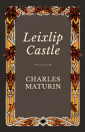
Melmoth the Wanderer

· Graphic Arts Books
Ebook
558
Pages
Tools
Eligible

About this ebook

Melmoth the Wanderer (1820) is a novel by Charles Maturin. Written toward the end of Maturin’s life, Melmoth the Wanderer was the author’s fifth and most successful novel. Inspired by the story of the Wandering Jew and the Faustian legend, the novel is a powerful Gothic romance divided into nested stories, each one delving deeper into the mystery of Melmoth’s life. Often interpreted for its criticisms of 19th century Britain and the Catholic Church, Melmoth the Wanderer is considered one of the greatest novels of the Romantic era. Following a lead from a story told at his uncle’s funeral, John Melmoth, a student from Dublin, begins an obsessive search into his family’s mysterious past. Little is known about the man called “Melmoth the Traveller.” A portrait dated 1646 suggests that he has been dead for over a century. Despite this, he discovers a manuscript from a stranger named Stanton who claims to have seen Melmoth on several occasions over the past few decades. John tracks him down and finds him at a mental institution, where he was placed when his obsession with Melmoth was deemed insanity. Disturbed, John burns the portrait and attempts to put his questions behind him. Soon, he begins having visions of his own. Melmoth the Wanderer is a story of mystery and terror that engages with timeless themes of faith, fantasy, and the thin line between dreams and life. With a beautifully designed cover and professionally typeset manuscript, this edition of Charles Maturin’s Melmoth the Wanderer is a classic of Irish literature reimagined for modern readers.
Melmoth the Wanderer (1820) is a novel by Charles Maturin. Written toward the end of Maturin’s life, Melmoth the Wanderer was the author’s fifth and most successful novel. Inspired by the story of the Wandering Jew and the Faustian legend, the novel is a powerful Gothic romance divided into neste...

Discover more

About the author

Charles Maturin (1780-1824) was an Irish writer and clergyman. Born and raised in Dublin, Maturin was raised in a prominent Huguenot family. Educated at Trinity College, he became ordained as curate of Loughrea, County Galway, before returning to Dublin in 1903. Due to his position in the Church of Ireland, he was forced to publish his writing under a pseudonym, achieving some acclaim for his early novels. In 1816, his play Bertram was staged at the Drury Lane theatre in London. Although he was encouraged by Sir Water Scott and Lord Byron, he received a devastating review from Samuel Taylor Coleridge, who deemed the play “melancholy proof of the depravation of the public mind.” Forced to reveal his identity in order to claim his profits, Maturin was barred from advancement by the Church of Ireland and turned his attention to novel writing. In 1820, his Gothic novel Melmoth the Wanderer was published to critical acclaim, earning Maturin a reputation as a leading Romantic, influencing such writers as Charles Baudelaire and Honoré de Balzac. Controversial in his lifetime, viewed as an eccentric in his native country, Maturin would serve as inspiration to his grandnephew Oscar Wilde, as well as countless writers, artists, and aesthetes.

Charles Maturin (1780-1824) was an Irish writer and clergyman. Born and raised in Dublin, Maturin was raised in a prominent Huguenot family. Educated at Trinity College, he became ordained as curate of Loughrea, County Galway, before returning to Dublin in 1903. Due to his position in the Church ...

Rate this ebook

Tell us what you think.

Reading information

Smartphones and tablets
Install the Google Play Books app for Android and iPad/iPhone. It syncs automatically with your account and allows you to read online or offline wherever you are.
Laptops and computers
You can listen to audiobooks purchased on Google Play using your computer's web browser.
eReaders and other devices
To read on e-ink devices like Kobo eReaders, you'll need to download a file and transfer it to your device. Follow the detailed Help Center instructions to transfer the files to supported eReaders.