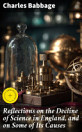
Reflections on the Decline of Science in England: Restored Classics to Go Edition

· Otbebookpublishing
Ebook
200
Pages
Eligible

About this ebook

Charles Babbage delivers a fierce, witty indictment of English science, arguing that Britain is falling behind Europe through neglect, complacency, and bad institutional habits. He cites leading British and continental authorities, praises the rigor of French and German scientific publications, and insists that open criticism is necessary if truth and reform are to prevail. The work is both a defense of accountability and a warning that science cannot thrive where prestige matters more than serious inquiry. At the center of the critique is the Royal Society and the broader system that supports science in England. Babbage attacks its finances, its distribution of offices, its leadership, and its wasteful spending on engravings, publications, and lavishly printed Greenwich Observations, even when working astronomers struggle to obtain them. He also traces the decline to education, arguing that universities overvalue classics and narrow mathematics while neglecting practical and scientific knowledge. His proposed reforms call for broader examinations in history, law, political economy, chemistry, geology, zoology, and botany, so degrees reflect real learning and prepare students for modern life. This edition has been fully restored with modern typesetting, custom cover design.
Charles Babbage delivers a fierce, witty indictment of English science, arguing that Britain is falling behind Europe through neglect, complacency, and bad institutional habits. He cites leading British and continental authorities, praises the rigor of French and German scientific publications, a...

Discover more

About the author

Charles Babbage was an English mathematician, inventor, and visionary thinker born in 1791, best known today as one of the great pioneers of computing and a restless critic of the scientific culture of his time. Educated at Cambridge, he became deeply involved in mathematics, engineering, and public reform, and spent much of his life pursuing ambitious mechanical designs that anticipated the modern computer. Alongside his technical work, he wrote influential nonfiction that examined the state of science, industry, and intellectual life in Britain, arguing for better support of research, more rigorous methods, and a stronger partnership between knowledge and practical progress. His writing often returns to themes of efficiency, precision, innovation, and the social responsibility of science, ideas that remain strikingly relevant in an age shaped by technology, data, and debates over how expertise should serve the public good. Babbage's legacy lies not only in his mechanical foresight but in his insistence that scientific progress depends on institutions, incentives, and imagination working together. Modern readers still find him compelling because he speaks to enduring questions about innovation, bureaucracy, and the future of human ingenuity. He will especially appeal to readers interested in the history of science, the origins of computing, and thoughtful arguments about how societies nurture discovery.

Charles Babbage was an English mathematician, inventor, and visionary thinker born in 1791, best known today as one of the great pioneers of computing and a restless critic of the scientific culture of his time. Educated at Cambridge, he became deeply involved in mathematics, engineering, and pub...

Rate this ebook

Tell us what you think.

Reading information

Smartphones and tablets
Install the Google Play Books app for Android and iPad/iPhone. It syncs automatically with your account and allows you to read online or offline wherever you are.
Laptops and computers
You can listen to audiobooks purchased on Google Play using your computer's web browser.
eReaders and other devices
To read on e-ink devices like Kobo eReaders, you'll need to download a file and transfer it to your device. Follow the detailed Help Center instructions to transfer the files to supported eReaders.