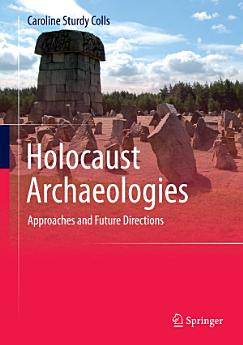
Holocaust Archaeologies: Approaches and Future Directions

· Springer
Ebook
358
Pages

About this ebook

Holocaust Archaeologies: Approaches and Future Directions aims to move archaeological research concerning the Holocaust forward through a discussion of the variety of the political, social, ethical and religious issues that surround investigations of this period and by considering how to address them. It considers the various reasons why archaeological investigations may take place and what issues will be brought to bear when fieldwork is suggested. It presents an interdisciplinary methodology in order to demonstrate how archaeology can (uniquely) contribute to the history of this period. Case examples are used throughout the book in order to contextualise prevalent themes and a variety of geographically and typologically diverse sites throughout Europe are discussed. This book challenges many of the widely held perceptions concerning the Holocaust, including the idea that it was solely an Eastern European phenomena centred on Auschwitz and the belief that othersites connected to it were largely destroyed or are well-known. The typologically , temporally and spatial diverse body of physical evidence pertaining to this period is presented and future possibilities for investigation of it are discussed. Finally, the volume concludes by discussing issues relating to the “re-presentation” of the Holocaust and the impact of this on commemoration, heritage management and education. This discussion is a timely one as we enter an age without survivors and questions are raised about how to educate future generations about these events in their absence.
Holocaust Archaeologies: Approaches and Future Directions aims to move archaeological research concerning the Holocaust forward through a discussion of the variety of the political, social, ethical and religious issues that surround investigations of this period and by considering how to address ...

Discover more

About the author

Dr Caroline Sturdy Colls is an Associate Professor at Staffordshire University specialising in forensic and Holocaust archaeology. She is also the Research Lead and founder of the Centre of Archaeology at the same institution. Her research focuses on the application of interdisciplinary approaches to the investigation of Holocaust landscapes. As part of this research, she completed the first archaeological surveys of the former extermination camp at Treblinka (Poland), the sites pertaining to the slave labour programme in Alderney (the Channel Islands) and the former Semlin Judenlager and Anhaltlager (Serbia). She has published extensively in Holocaust and forensic archaeology. Her research has received international media attention via television documentaries and radio programmes aired in Europe and the US. She also acts as a Scientific Advisor for Kamp Westerbork and sits on the NWO Holocaust Archaeology Group. Caroline is also a Consultant for the Polish-German Reconciliation Foundation, searching for mass graves of the Holocaust across Poland. Caroline is also a member of the Forensic Archaeology Expert Panel and regularly undertakes forensic search and recovery work with UK Police forces. Her particular interests in this field include the application of forensic archaeological methods to the investigation of cold cases and socio-historic conflicts. She is also a Member of the Institute For Archaeologists (MIFA) and a Member and Assessor for the Chartered Society of Forensic Sciences (MCSFS). As the Research Lead of the Centre of Archaeology, her interest in archaeology goes beyond the recent past and she has managed a number of large-scale research and consultancy projects across Europe.
Dr Caroline Sturdy Colls is an Associate Professor at Staffordshire University specialising in forensic and Holocaust archaeology. She is also the Research Lead and founder of the Centre of Archaeology at the same institution. Her research focuses on the application of interdisciplinary approache...

Rate this ebook

Tell us what you think.

Reading information

Smartphones and tablets
Install the Google Play Books app for Android and iPad/iPhone. It syncs automatically with your account and allows you to read online or offline wherever you are.
Laptops and computers
You can listen to audiobooks purchased on Google Play using your computer's web browser.
eReaders and other devices
To read on e-ink devices like Kobo eReaders, you'll need to download a file and transfer it to your device. Follow the detailed Help Center instructions to transfer the files to supported eReaders.