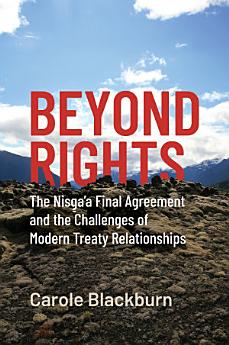
Beyond Rights: The Nisg̱a’a Final Agreement and the Challenges of Modern Treaty Relationships
About this ebook
The Nisg̱a’a were trailblazers in gaining Supreme Court recognition of unextinguished Aboriginal title, and the treaty marked a turning point in the relationship between First Nations and provincial and federal governments. By embedding three key elements – self-government, title, and control of citizenship – the Nisg̱a’a treaty tackled fundamental issues concerning state sovereignty, the underlying title of the Crown, and the distribution of rights.
Using this pivotal case study, Beyond Rights analyzes both the potential and the limits of treaty making as a way to address historical injustice and to achieve contemporary legal recognition. It also assesses the possibilities for a distinct Indigenous citizenship in a settler state with a long history of exclusion and assimilation.
Discover more
About the author
Carole Blackburn is an associate professor in the Department of Anthropology at the University of British Columbia and the author of Harvest of Souls: Jesuit Missions and Colonialism in North America, 1632–1650. She has been researching the Nisg̱a’a Final Agreement since 1999, conducting interviews and engaging in participant observation with treaty negotiators, politicians, bureaucrats, Nisg̱a’a citizens, government workers, and lawyers for the province, the federal government, and the Nisg̱a’a.