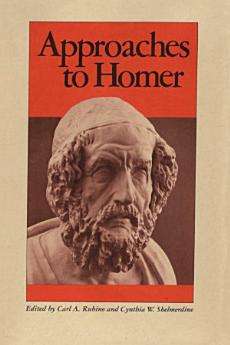
Approaches to Homer

·
· University of Texas Press
Ebook
294
Pages
Tools

About this ebook

Modern Homeric scholarship is distinguished by a dazzling diversity of approaches. That diversity is brilliantly displayed in this volume, in which nine well-known classicists approach the Homeric poems from the various perspectives of archaeology, economic history, philosophy, literary criticism, linguistics, and Byzantine history.

Several essays are primarily concerned with what the Homeric poems teach us about the past. Richard Hope Simpson, for example, reviews the controversy sparked by his and John F. Lazenby's 1970 argument that the Catalogue of Ships in the Iliad accurately reflects the geography of Mycenean Greece. Using archaeology as just one of his starting points, Gregory Nagy reflects upon the death and funeral of Sarpedon as described in the Iliad. Our understanding of the word áté is enhanced by E. D. Francis, who closely examines its prehistory.

Norman Austin's elegant and original discussion of tone in the Odyssey's Cyclops tale is animated by both psychoanalytic theory and his work with two practitioners of optometric visual training. Writing of Odysseus, James M. Redfield dubs that hero "the economic man" and links certain tensions in the Odyssey to the actual economic concerns of Greece in the late eighth century BC. Both Ann L. T. Bergren and Mabel L. Lang concern themselves with problems of narrative in the Homeric epics.

Like Hope Simpson, C. J. Rowe updates a controversy—in this instance, the many objections raised to Arthur Adkins' influential 1960 study of moral values in Homer. Gareth Morgan provides a fascinating glimpse of the Homeric scholarship of another day by focusing on the work of the astonishing John Tzetzes in twelfth-century Byzantium.
Modern Homeric scholarship is distinguished by a dazzling diversity of approaches. That diversity is brilliantly displayed in this volume, in which nine well-known classicists approach the Homeric poems from the various perspectives of archaeology, economic history, philosophy, literary criticism...

About the author

Carl A. Rubino is Winslow Professor of Classics and Chair of the Department of Classics at Hamilton College. Cynthia W. Shelmerdine is Robert M. Armstrong Centennial Professor Emeritus of Classics at the University of Texas at Austin.

Rate this ebook

Tell us what you think.

Reading information

Smartphones and tablets
Install the Google Play Books app for Android and iPad/iPhone. It syncs automatically with your account and allows you to read online or offline wherever you are.
Laptops and computers
You can listen to audiobooks purchased on Google Play using your computer's web browser.
eReaders and other devices
To read on e-ink devices like Kobo eReaders, you'll need to download a file and transfer it to your device. Follow the detailed Help Center instructions to transfer the files to supported eReaders.