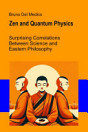
About this ebook
However, the 20th century marks a break. With quantum physics, the concept of the isolated "object" loses its solidity. In 1927, Werner Heisenberg formulates the uncertainty principle. Niels Bohr states that the observer and the observed are inseparable. Particles do not simply "be" in one place: they exist as probabilities, relationships, fields of interaction. Reality is not like a clock. It is more like a wave that passes through everything.
These insights are surprisingly in dialogue with certain philosophical traditions. In the Tao Te Ching, attributed to Laozi, the universe is not a collection of parts, but a single flow, a Tao. In Buddhist thought, the idea of "interbeing" dissolves the rigid boundaries of the individual. Even in the West, philosophers such as Spinoza and Whitehead have suggested a relational view, in which each entity is defined by its relationship to the whole.
The paradox is that we still live in an age obsessed with fragmentation. Politics is divided into irreconcilable factions. Scientific disciplines struggle to communicate and interconnect with each other. Society is segmented into closed cultures and groups. Even psychology breaks down human beings into separate "functions" and "processes." In this context, unifying thought is not just an intellectual curiosity: it appears as a provocation.
Rethinking the universe as a continuous fabric may not be an abstract luxury, but a cultural necessity. As physicist David Bohm, a student of Einstein, wrote: "Fragmentation is the main problem of humanity." Perhaps it is time to return to looking not only at the gears, but at the mystery of the movement that holds them together.
Let's imagine transposing the insights of quantum physics and unitary philosophies into everyday life. The first impact would be a change in language. The words we use are not neutral: they define what we think is real. If we said "system" instead of "object," "relationship" instead of "boundary," our perception would be transformed.
In physics, this conceptual revolution has already produced powerful tools. Lasers, semiconductors, and magnetic resonance imaging would not be possible without the idea that matter is a field of invisible interactions. Similarly, in biology, the network of relationships between ecosystems challenges the old causal determinism: the bee is not just an "insect," but a vital node in the fabric of the entire planet.
On a social level, thinking in terms of interconnection can become a strategy for addressing global crises. Climate change, pandemics, and food security are not "someone else's problems": they belong to a single planetary system.
Even in psychology, a unifying approach can redefine key concepts. Carl Gustav Jung saw the individual as part of a collective unconscious. More recently, social neuroscience shows that the human brain is "programmed" for empathic connections. The self and the other are not separate universes: they share a common emotional and cognitive territory. The absence of fragmentation is not a mystical dream or . It is a direction of travel. Many chapters of the book are devoted to providing useful suggestions for integrating unity into personal and social life.
Discover more
About the author
Bruno Del Medico, born in 1946 in Sabaudia (Italy), worked in IT and software development throughout his career. He then devoted himself to studying and disseminating the most current scientific theories, such as quantum theory in its metaphysical sense. Bruno Del Medico is currently the author of numerous works published by Edizioni PensareDiverso. Bruno Del Medico's work stands out from traditional narratives in the field of technical sciences for its critical, independent, and unconventional approach. Instead of limiting himself to standard interpretations or general consensus on purely scientific issues, Bruno Del Medico explores alternative perspectives that often go against the grain, questioning commonly accepted assumptions.
A distinctive feature of his works is his ability to weave science, ethics, and philosophy into an open dialogue that encourages readers to think for themselves and consider the deeper implications of technological and scientific innovations.