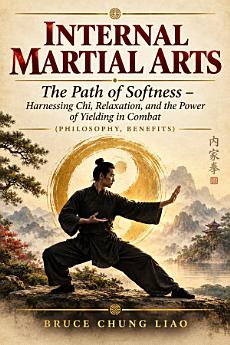
About this ebook
A MARTIAL ART BUILT ON YIELDING, NOT FORCE
Most people meet the internal martial arts in one of two misleading forms: gentle, slow-motion exercise in a park, or vague talk of invisible energy and masters who never seem to get hit. Bruce Chung Liao rejects both pictures. Drawing on documented history, Taoist philosophy and current research into fascia, relaxation and motor control, this book explains what "internal" actually meant to the seventeenth-century martial artists who coined the term, how chi is best understood as a traditional framework for breath, circulation and coordinated bodily sensation rather than a mystical force, and how softness in the joints becomes real, usable power in the hands, the stance and the strike.
WHAT YOU WILL LEARN
Across twelve chapters organised into three parts, the book moves from roots to application. Part One covers the documented lineages of Tai Chi, Xingyi and Bagua, the Taoist ideas of yin, yang and wu wei that shaped them, and an honest, evidence-aware treatment of chi and energy work. Part Two takes the philosophy into the body: standing practice and rooting, dantian breathing, the sensitivity training known as push hands, and the specific mechanism by which relaxed structure converts an opponent's incoming force into your own outgoing power. Part Three puts all of it to work, covering the combat case for softness as a genuine self-defense strategy against harder styles, how to build a martial arts training routine that actually progresses, the researched health benefits of this practice for stress, balance, joint health and conditions such as Parkinson's disease, and how to keep developing once the beginner stage is behind you.
WHO THIS BOOK IS WRITTEN FOR
This is for the martial artist who has trained in a harder style for years, picked up a string of shoulder, knee or back injuries from meeting force with force, and wants to understand a genuinely different mechanical approach. It is for the reader who has heard that Tai Chi or Qigong might help with stress, tension or an ageing body, and wants a serious explanation rather than a park class with no context. It is for anyone who tried an internal art once, found the slow forms baffling, and gave up before anyone explained why the slowness matters. And it is for the simply curious reader who wants the real history of these traditions, including where the record is genuinely uncertain, told straight rather than dressed up.
WHY THIS BOOK IS DIFFERENT
Internal Martial Arts: The Path of Softness does not promise mystical power or ask you to take anything on faith. Historical claims are checked against documented scholarship, with legend clearly separated from established fact. Chi is treated honestly, as a traditional Chinese framework for real, trainable sensations rather than a measured physical force. Every principle is explained mechanically, so you understand why a relaxed structure absorbs and redirects force rather than simply being told that it does. The result is a grounded, complete guide to Tai Chi Chuan, Xingyi Quan and Baguazhang that respects both the tradition and the reader's intelligence.
Discover more
About the author
Bruce Chung Liao has spent years studying and teaching the internal martial arts, and wrote this book for students who were told to relax long before anyone explained what that word actually means in combat.