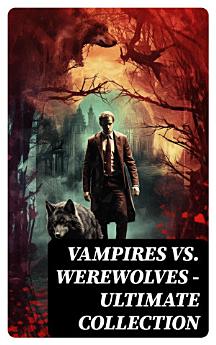
Vampires vs. Werewolves – Ultimate Collection: Dracula, Isle of the Undead, Four Wooden Stakes, The Mark of the Beast, The Horror-Horn...
Bram Stoker · Théophile Gautier · Rudyard Kipling · Eugene Field · Clemence Housman · Thomas Peckett Prest · James Malcolm Rymer · George Sylvester Viereck · Victoria Glad · Anthony Pelcher · Henry Kuttner · Earl Peirce · Lloyd Arthur Eshbach · Dudley Wright · Caroline Taylor Stewart · Hume Nisbet · John William Polidori · E. F. Benson · George W. M. Reynolds · Robert E. Howard · Sabine Baring-Gould · Richard Francis Burton · Marie de France · Sheridan Le Fanu · Jan Neruda · Claude Askew · Alice Askew · Émile Erckmann · Alexandre Chatrian · Victor Rowan · Alexandre Dumas Père · Gladys Gordon Trenery · Clifford Ball
Nov 2023 · DigiCat
Ebook
4319
Pages
family_home
Eligible
info
About this ebook
The 'Vampires vs. Werewolves – Ultimate Collection' offers an unparalleled journey into the murky depths of vampire and werewolf lore, showcasing a magnificent array of literary styles and cultural perspectives. From atmospheric Gothic fiction to thrilling tales of adventure, this anthology brings together stories that delve into the primal fears and universal themes of transformation and the supernatural. The collection seamlessly blends classic and lesser-known works, from the terror-filled vaults of the Gothic period to the intrigue of Victorian horror literature, capturing the essence of the iconic vampire and werewolf conflict. Standout tales within the anthology explore the nuanced relationship between hunter and prey, both macabre and reflective. The anthology's impressive lineup of authors, including timeless figures like Bram Stoker and John William Polidori, as well as influential genre pioneers such as Robert E. Howard and E. F. Benson, represents a vibrant tapestry of voices across historical and literary milestones. These celebrated contributors hail from various cultural movements and geographies, each bringing a distinct perspective to the supernatural realm. Through the diverse frameworks of their stories, the authors collectively challenge societal norms, explore human duality, and evoke an enduring fascination with the monstrous. Readers are invited to uncover a wealth of perspectives and artistic expressions within 'Vampires vs. Werewolves – Ultimate Collection,' a superbly curated anthology that rewards with its depth and diversity. It provides a captivating scholarly and immersive experience, engaging both dedicated fans of the genres and scholars interested in the cultural implications of such mythologies. This collection is not just a journey through tales of the supernatural but also a dialogue with the artistic and existential questions these creatures provoke, making it an essential addition to any literary and cultural exploration.
The 'Vampires vs. Werewolves – Ultimate Collection' offers an unparalleled journey into the murky depths of vampire and werewolf lore, showcasing a magnificent array of literary styles and cultural perspectives. From atmospheric Gothic fiction to thrilling tales of adventure, this anthology bring...
Discover more
About the author
Abraham 'Bram' Stoker (1847–1912) was an Irish author, best known for his Gothic masterpiece 'Dracula' (1897). Stoker's contribution to the genre of horror fiction is incalculable, influencing countless adaptations and spin-offs. Born in Dublin, Ireland, he battled through a sickness-ridden childhood, which perhaps shaped the macabre in his literary undertakings. Stoker was a civil servant at Dublin Castle for a decade before developing a secondary career in writing. His early works garnered mild attention, but it was the publication of 'Dracula' that solidified his position as a preeminent Gothic novelist. The novel introduced the character of Count Dracula and established many conventions of subsequent vampire fantasy. The themes of his work often delve into the psychological, the taboo, and the clash between modernity and ancient superstitions. While 'Vampires vs. Werewolves – Ultimate Collection' is not one of his authentic works, it represents the legacy of lore that Stoker popularised. His literary style combined detailed realism with the supernatural, making him a pioneer for future horror and fantasy writers. In his lifetime, Stoker was better known as the manager of the Lyceum Theatre in London, where he was a business associate of the famous actor Henry Irving. Stoker's novels reflect a deep preoccupation with the Victorian concerns of his era, including sexuality, immigration, and the advancement of technology. Bram Stoker's work has endured well beyond his lifetime, ensuring his place as a titan in the pantheon of horror literature.
Abraham 'Bram' Stoker (1847–1912) was an Irish author, best known for his Gothic masterpiece 'Dracula' (1897). Stoker's contribution to the genre of horror fiction is incalculable, influencing countless adaptations and spin-offs. Born in Dublin, Ireland, he battled through a sickness-ridden child...
Rate this ebook
Tell us what you think.
Reading information
Smartphones and tablets
Install the Google Play Books app for Android and iPad/iPhone. It syncs automatically with your account and allows you to read online or offline wherever you are.
Laptops and computers
You can listen to audiobooks purchased on Google Play using your computer's web browser.
eReaders and other devices
To read on e-ink devices like Kobo eReaders, you'll need to download a file and transfer it to your device. Follow the detailed Help Center instructions to transfer the files to supported eReaders.