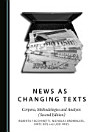
News as Changing Texts: Corpora, Methodologies and Analysis

·
· Cambridge Scholars Publishing
Ebook
250
Pages
Eligible

About this ebook

This book focuses on the dialectic interrelation between ‘news’ and ‘change’, whereby news is intended as a textual type in its evolutionary – and revolutionary – development, while change is discussed with reference to the form, content and structure of such typological variety explored across the centuries, largely in the British environment.

The time spans in the chapters have been distributed according to (a) historical key moments in the process of news-writing changes, and (b) extant computerized corpora covering such periods, thereby permitting specific linguistic analyses. Indeed, each chapter makes use of a set of corpora specifically devised to suit the needs of scholars studying the periods under scrutiny.

The topics discussed and the corpora exploited to analyze them call into question basic methodological issues that are tackled from different perspectives in the book, while the epicentre of all research remains the news itself, in a continuous process of adjustment and renewal.

This book focuses on the dialectic interrelation between ‘news’ and ‘change’, whereby news is intended as a textual type in its evolutionary – and revolutionary – development, while change is discussed with reference to the form, content and structure of such typological variety explored across t...

Discover more

About the author

Roberta Facchinetti is Professor of English Language and Linguistics at the University of Verona, Italy. Her main research fields focus on media linguistics, language description and pragmatics, with special reference to how language is used to negotiate social and discourse roles. This is done mostly by means of computerized corpora of both synchronic and diachronic English. On the subject she has authored, co-authored and edited various books and articles, among which are Corpus Linguistics 25 Years On (2007) and From International to Local English – And Back Again (2010) with David Crystal and Barbara Seidlhofer.

Nicholas Brownlees is Associate Professor of English Language at the University of Florence, Italy. He has written extensively on early modern news and is the author of The Language of Periodical News in Seventeenth-Century England (2011). He is also editor of News Discourse in Early Modern Britain (2006) and co-editor of The Language of Public and Private Communication in a Historical Perspective (2010).

Birte Bös is currently Guest Professor of Applied Linguistics at the University of Augsburg, Germany, and has worked as a Junior Professor of English Linguistics at the University of Rostock. Her research interests include synchronic and diachronic pragmatics, discourse analysis and media linguistics. Based on the Rostock Newspaper Corpus (RNC), which is currently being extended, she has investigated the communicative practices of historical and modern news discourse.

Udo Fries was Professor of English Linguistics at the University of Zurich, Switzerland, until his retirement in 2007. He has published widely in the fields of English philology, syntax and text linguistics. In recent years he has concentrated on work in computer corpus linguistics, producing ZEN (The Zurich English Newspaper Corpus), a corpus of 17th- and 18th-century English newspapers.

Roberta Facchinetti is Professor of English Language and Linguistics at the University of Verona, Italy. Her main research fields focus on media linguistics, language description and pragmatics, with special reference to how language is used to negotiate social and discourse roles. This is done m...

Rate this ebook

Tell us what you think.

Reading information

Smartphones and tablets
Install the Google Play Books app for Android and iPad/iPhone. It syncs automatically with your account and allows you to read online or offline wherever you are.
Laptops and computers
You can listen to audiobooks purchased on Google Play using your computer's web browser.
eReaders and other devices
To read on e-ink devices like Kobo eReaders, you'll need to download a file and transfer it to your device. Follow the detailed Help Center instructions to transfer the files to supported eReaders.