关于此电子书
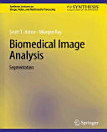
In biological and medical imaging applications, tracking objects in motion is a critical task. This book describes the state-of-the-art in biomedical tracking techniques. We begin by detailing methods for tracking using active contours, which have been highly successful in biomedical applications. The book next covers the major probabilistic methods for tracking. Starting with the basic Bayesian model, we describe the Kalman filter and conventional tracking methods that use centroid and correlation measurements for target detection. Innovations such as the extended Kalman filter and the interacting multiple model open the door to capturing complex biological objects in motion. A salient highlight of the book is the introduction of the recently emerged particle filter, which promises to solve tracking problems that were previously intractable by conventional means. Another unique feature of Biomedical Image Analysis: Tracking is the explanation of shape-based methods for biomedical image analysis. Methods for both rigid and nonrigid objects are depicted. Each chapter in the book puts forth biomedical case studies that illustrate the methods in action.
In biological and medical imaging applications, tracking objects in motion is a critical task. This book describes the state-of-the-art in biomedical tracking techniques. We begin by detailing methods for tracking using active contours, which have been highly successful in biomedical applications...
探索更多
作者简介
Scott T. Acton received the M.S. degree in electrical and computer engineering and the Ph.D. degree in electrical and computer engineering from the University of Texas at Austin in 1990 and 1993, respectively, where he was a Microelectronics and Computer Development Fellow. He received the B.S. degree in electrical engineering from Virginia Tech, Blacksburg in 1988 as a Virginia Scholar and Marshall Hahn Fellow. He was the class of 1984 valedictorian at Oakton High School in Vienna, VA. At Oakton, he was a member of the football and basketball teams, although the coach rarely let him in an actual game. He has worked in industry for AT&T, Oakton, VA, the MITRE Corporation, McLean, VA, and Motorola, Inc., Phoenix, AZ and in academia for Oklahoma State University, Stillwater. Currently, he holds the Walter N. Munster Chair for Intelligence Enhancement at the University of Virginia (U.Va.), where he is a member of the Charles L. Brown Department of Electrical and Computer Engineering and the Department of Biomedical Engineering. At U.Va., he was named the Outstanding New Teacher in 2002 and was elected a Faculty Fellow in 2003. For his research in video tracking, he was given an ARO Young Investigator Award. He received the Halliburton Outstanding Young Faculty Award in 1998. In 1997, he was named the Eta Kappa Nu Outstanding Young Electrical Engineer (a national award that has been given annually since 1936). He is the recipient of a Whitaker Foundation Biomedical Engineering Research Grant for work in cell detection and tracking. He currently is working on NIH-funded research for leukocyte tracking, segmentation of the myocardium from ultrasound, and segmentation of the myocardium from MRI. Dr. Acton is an active participant in the IEEE, served as Associate Editor for the IEEE Transactions on Image Processing and as Associate Editor for the IEEE Signal Processing Letters. He is the 2004 Technical Program Chair and the 2006 General Chair for the Asilomar Conference onSignals, Systems and Computers. His research interests include anisotropic diffusion, the history of Billy the Kid, active contours, biomedical segmentation problems, biomedical tracking problems, and war. Acton was a 2005 finalist in the Florida First Coast Novel Contest. He lives in beautiful Charlottesville, Virginia, with his wife and two boys. Nilanjan Ray received Bachelor of Mechanical Engineering from Jadavpur University, Calcutta, India in 1995; Master of Technology in computer science from Indian Statistical Institute, Calcutta, India in 1997; and Doctor of Philosophy in electrical engineering from the University of Virginia, Charlottesville, in 2003. From 2003 to 2005, he held a postdoctoral researcher position at C.L. Brown Department of Electrical and Computer Engineering, University of Virginia. Currently he is a senior research scientist at UtopiaCompression Corporation, Los Angeles, CA. Dr. Ray is a recipient of CIMPA-UNESCO fellowship for image processing school in 1999, graduate fellowship at Indian Statistical Institute from 1995 to 1997, best student paper award at IEEE international conference on image processing, held at Rochester, NY, 2002, from the IBM Picture Processing Society. Dr. Ray's research interests include object tracking using sequential Monte Carlo methods, applications of partial differential equations in image and video processing, image registration, and image denoising. Dr. Ray lives on the beach in LA with his wife and son.
Scott T. Acton received the M.S. degree in electrical and computer engineering and the Ph.D. degree in electrical and computer engineering from the University of Texas at Austin in 1990 and 1993, respectively, where he was a Microelectronics and Computer Development Fellow. He received the B.S. d...
为此电子书评分
欢迎向我们提供反馈意见。
如何阅读
智能手机和平板电脑
笔记本电脑和台式机
您可以使用计算机的网络浏览器聆听您在 Google Play 购买的有声读物。
电子阅读器和其他设备
如果要在 Kobo 电子阅读器等电子墨水屏设备上阅读,您需要下载一个文件,并将其传输到相应设备上。若要将文件传输到受支持的电子阅读器上,请按帮助中心内的详细说明操作。