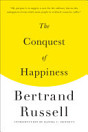
The Conquest of Happiness
About this ebook
Despite living in nations where basic needs are met—even surpassed—and where an abundance of modern conveniences have reduced dangerous physical labor, people suffer from an affliction of despair. Beliefs and habits taught in childhood about what to value and how to behave have hindered generations from embracing the joys that life has to offer. Concerns with wealth, social status, and morality create personal anxieties. Brooding about mistakes and fears closes people off from the opportunities and companionship that inspire an enthusiastic outlook even in times of adversity.
Originally published in 1930, renowned philosopher Bertrand Russell's The Conquest of Happiness explores the roots of the unhappiness epidemic and shares strategies on combating worrying, pessimistic, and self-absorbed thoughts that serve no purpose beyond inducing misery. Pursuing a fulfilling life requires disciplined effort to nurture pleasurable interests and activities beyond self-gratification, such as those that encourage curiosity in the outside world and foster connections with friends and family.
Optimistic and life-affirming, Russell's philosophy continues to offer an antidote for everyone struggling with insecurities and seeking ways to find meaning and purpose in life.
"Should be read by every parent, teacher, minister, and Congressman in the land." ― The Atlantic
About the author
Bertrand Arthur William Russell, 3rd Earl Russell was a British philosopher, logician, mathematician, historian, social reformer, and pacifist. Although he spent the majority of his life in England, he was born in Wales, where he also died. Russell led the British "revolt against Idealism" in the early twentieth century and is one of the founders of analytic philosophy along with his protégé Wittgenstein and his elder Frege. He co-authored, with A. N. Whitehead, Principia Mathematica, an attempt to ground mathematics on logic. His philosophical essay "On Denoting" has been considered a "paradigm of philosophy." Both works have had a considerable influence on logic, mathematics, set theory, linguistics and analytic philosophy. He was a prominent anti-war activist, championing free trade between nations and anti-imperialism. Russell was imprisoned for his pacifist activism during World War I, campaigned against Adolf Hitler, for nuclear disarmament. He criticized Soviet totalitarianism and the United States of America's involvement in the Vietnam War. In 1950, Russell was awarded the Nobel Prize in Literature, "in recognition of his varied and significant writings in which he champions humanitarian ideals and freedom of thought."