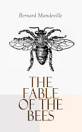
The Fable of the Bees: Enriched edition. A Satirical Allegory of Vice, Virtue, and the Economic Case for Public Benefit from Private Self-Interest
Bernard Mandeville
Nov 2022 · DigiCat
Ebook
535
Pages
family_home
Eligible
info
About this ebook
In "The Fable of the Bees," Bernard Mandeville presents a provocative and satirical critique of society that intertwines moral philosophy with economic theory. Set in the early 18th century, the work unfolds as an allegorical tale where a bee community embodies the complexities of human vice and virtue. Mandeville employs an innovative verse form and a blend of humor and sharp observation, delivering a message that challenges the contemporary moralistic view of individual actions as inherently good or bad. He posits that private vices can lead to public benefits, igniting debates about economic growth and ethical self-interest that resonate through the ages. Bernard Mandeville, a Dutch philosopher and economist, was a pioneer of social thought whose ideas were often at odds with the prevailing moral philosophies of his time. His background as a physician and a scholar exposed him to both the intricacies of human behavior and the emerging economic theories of the Enlightenment. Mandeville's keen awareness of the tensions between personal morality and societal welfare profoundly shaped his work, enabling him to articulate a revolutionary perspective on the interplay of ethics and economics. This seminal text is indispensable for those seeking to understand the foundations of modern economic thought and moral philosophy. Readers will appreciate Mandeville's unapologetic examination of human nature, and the book will inspire critical reflection on the delicate balance between individual desires and societal goods. In this enriched edition, we have carefully created added value for your reading experience: - A comprehensive Introduction outlines these selected works' unifying features, themes, or stylistic evolutions. - A Historical Context section situates the works in their broader era—social currents, cultural trends, and key events that underpin their creation. - A concise Synopsis (Selection) offers an accessible overview of the included texts, helping readers navigate plotlines and main ideas without revealing critical twists. - A unified Analysis examines recurring motifs and stylistic hallmarks across the collection, tying the stories together while spotlighting the different work's strengths. - Reflection questions inspire deeper contemplation of the author's overarching message, inviting readers to draw connections among different texts and relate them to modern contexts. - Lastly, our hand‐picked Memorable Quotes distill pivotal lines and turning points, serving as touchstones for the collection's central themes.
In "The Fable of the Bees," Bernard Mandeville presents a provocative and satirical critique of society that intertwines moral philosophy with economic theory. Set in the early 18th century, the work unfolds as an allegorical tale where a bee community embodies the complexities of human vice and ...
About the author
Bernard Mandeville, a Dutch-born English philosopher, political economist, and satirist, is widely known for his seminal work 'The Fable of the Bees: or, Private Vices, Publick Benefits', first published in 1714. Mandeville's controversial thesis in 'The Fable of the Bees' centers on the paradox that society benefits from the selfish actions of individuals—a viewpoint that predated and influenced the later economic theories of Adam Smith. Born in 1670 in Rotterdam, Netherlands, Mandeville received a doctorate in philosophy and medicine from the University of Leiden before moving to England. His work often critiqued and challenged prevailing moral and economic assumptions of his time. His pamphlet 'The Fable of the Bees' began as a modest poem titled 'The Grumbling Hive', but as it generated both interest and outrage, Mandeville expanded it with a series of extensive commentaries and elaborations. This expansion explored the intersection of ethics and economics, sparking vigorous debate among contemporaries. Mandeville's influence extends beyond economics to the realm of ethics and sociological theory; his writings provoke reflection on the complex interplay between individual actions and societal well-being. Mandeville died in 1733, leaving a legacy as an incisive and unorthodox thinker whose work continues to be studied for its impact on Enlightenment thought and classical economic theory.
Bernard Mandeville, a Dutch-born English philosopher, political economist, and satirist, is widely known for his seminal work 'The Fable of the Bees: or, Private Vices, Publick Benefits', first published in 1714. Mandeville's controversial thesis in 'The Fable of the Bees' centers on the paradox ...
Rate this ebook
Tell us what you think.
Reading information
Smartphones and tablets
Install the Google Play Books app for Android and iPad/iPhone. It syncs automatically with your account and allows you to read online or offline wherever you are.
Laptops and computers
You can listen to audiobooks purchased on Google Play using your computer's web browser.
eReaders and other devices
To read on e-ink devices like Kobo eReaders, you'll need to download a file and transfer it to your device. Follow the detailed Help Center instructions to transfer the files to supported eReaders.