About this ebook
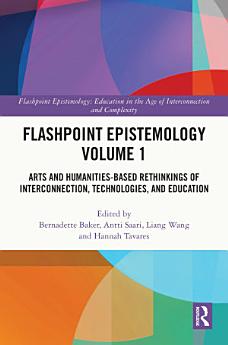
Flashpoint Epistemology Volume 1 examines contemporary collisions and reworkings of cultural-political issues in education through arts and humanities-based approaches. How and whether lines are (re)drawn in educational practice – and via who-what – between justice, morality, religion, ethics, subjectivities, intersectionality, the sublime, and the senses are a particular focus. The volume offers innovative relational approaches and new narrativization strategies, examining the aporia experienced when operating in educational domains of inevitable, recurring, difficult, fortuitous, and/or unforeseen flashpoints.
The chapters will engage researchers seeking new approaches to education’s complexities, nested discourses, and ever-moving horizons of enactment. It will also benefit post/graduate students and teachers whose work intersects with sociological, philosophical, and cultural studies and who are curious about claims to interconnection, the ethical quandaries embedded in practice, and the affordances and limits of technological innovation.
Discover more
About the author
Bernadette Baker is a Professor at the University of Wisconsin-Madison, Department of Curriculum and Instruction. Her work draws upon philosophy, history, comparative cosmology, and sociology as they intersect with curriculum studies, educational history and philosophy, and policies and practices focused on well-being, new technologies, and the effects of power.
Antti Saari is Associate Professor (tenure track) at Tampere University Faculty of Education and Culture. Saari’s studies on educational research and governance have analyzed how transnational discourses of educational research and expert knowledge are translated to practices of evaluation, classroom management, and the use of instructional technology.
Liang Wang received her Ph.D. degree in curriculum and instruction from the University of Wisconsin-Madison in 2022. She conducts transdisciplinary research in the transformation of education through digital technology, especially the digital recontouring of structural marginalization amid national and global education policy reform and technology-enhanced, anti-oppressive pedagogy.
Hannah Tavares is an Associate Professor in the Department of Educational Foundations at the University of Hawaiʻi at Mānoa. Her work explores the personal, relational, and diasporic, and the construction of geographical identity. Her practice draws from multiple cultural and disciplinary perspectives to examine the ambivalence and complexity of territorial and cultural boundaries. At the center of her work is the body, understood as a site of power and action.