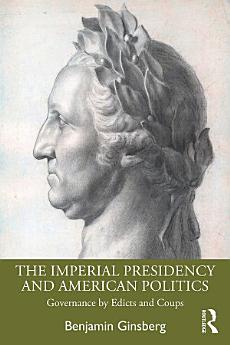
The Imperial Presidency and American Politics: Governance by Edicts and Coups
About this ebook
Though presidents are elected more or less democratically, the presidency is not and was never intended to be a democratic institution. The framers thought that America would be governed by its representative assembly, the Congress of the United States. Presidential power, like a dangerous pharmaceutical, might have been labelled, "to be used only when needed."
Today, Congress sporadically engages in law making but the president actually governs. Congress has become more an inquisitorial than a legislative body. Presidents rule through edicts while their opponents in the Congress counter with the threat of impeachment—an action that amounts to a political, albeit nonviolent coup. The courts sputter and fume but generally back the president. This is the new separation of powers—the president exercises power and the other branches are separated from it.
Where will this end? Regardless of who occupies the Oval Office, the imperial presidency is inexorably bringing down the curtain on American representative democracy.
Discover more
About the author
Benjamin Ginsberg is the David Bernstein Professor of Political Science and Chair of the Center for Advanced Governmental Studies at Johns Hopkins University, USA. He is the author, co-author, or editor of 30 books including The Fall of the Faculty; Presidential Government; Downsizing Democracy; The Captive Public; Politics By Other Means; and America’s State Governments: A Critical Look at Disconnected Democracies (Routledge, 2021). Ginsberg received his PhD from the University of Chicago in 1973 and was Professor of Government at Cornell until 1992 when he joined the Hopkins faculty.