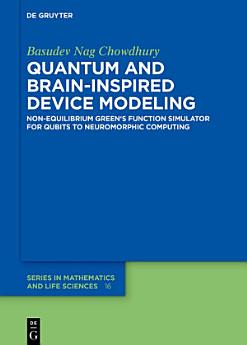
Quantum and Brain-Inspired Device Modeling: Non-Equilibrium Green’s Function Simulator for Qubits to Neuromorphic Computing

· De Gruyter Series in Mathematics and Life Sciences Book 16 · Walter de Gruyter GmbH & Co KG
Ebook
259
Pages
Tools

About this ebook

The book can be considered as a conceptual integration of two parallel emergent streams: quantum technology and brain-inspired computing, from the perspective of information processing. The book addresses the current issues associated with the non-equilibrium processes involved in either stream that cannot be explained by conventional semi-classical or equilibrium- statistical models. The purpose of this book is to provide a detailed explanation of how the non-equilibrium Green's function (NEGF) method can be utilized to develop quantum and brain-inspired device simulators. The book covers the fundamental concepts of NEGF and its relevance in describing communication between the quantum and classical world. It also outlines its applications in modeling quantum transport in ultra-scaled devices such as nano- MOS/MOSFETs, photodetectors, solar cells, LEDs, lasers, and metasurfaces. Additionally, the book discusses non-conventional phenomena related to phonons and electron spin in quantum devices. The NEGF method presented in the book is also used to model qubit operations as-well-as functional connectivity in brain and neuromorphic computing devices. Finally, based on the physical insights behind NEGF formalism, the book proposes exploring fractional dimensions to offer a new vision of the real world.
The book can be considered as a conceptual integration of two parallel emergent streams: quantum technology and brain-inspired computing, from the perspective of information processing. The book addresses the current issues associated with the non-equilibrium processes involved in either stream t...

Discover more

About the author

Dr. Basudev Nag Chowdhury received PhD in Nanoscience and Nanotechnology from University of Calcutta and continued as Postdoctoral fellow under World Bank’s project on Systems Biology. He got Bachelor’s degree in Physics from Presidency College, Kolkata and Master’s degree from Rajabazar Science College, India. He also worked as visiting researcher in the Department of Electronic Science, University of Calcutta. Dr. Nag Chowdhury is currently working as the Principal Research Scientist at IIT, Kharagpur, India and Research and Innovation Head at QSciT Research Private Limited. His significant research contributions include the channel exchange mechanism in high-energy scattering for entanglement generation, theoretical exploration and experimental demonstration of voltage-tunable quantum dots exhibiting room-temperature quantum confinement, their applications as qubits as well as high-efficiency solar cells, momentum quantization in nanotubes etc. Dr. Nag Chowdhury has published more than fifty research elements in reputed journals, conferences and book chapters including about twenty publications on non-equilibrium Green’s function. He has reviewed research articles, perspectives and reviews for numerous international journals. He has also received IOP Trusted Reviewer, 2022.
Dr. Basudev Nag Chowdhury received PhD in Nanoscience and Nanotechnology from University of Calcutta and continued as Postdoctoral fellow under World Bank’s project on Systems Biology. He got Bachelor’s degree in Physics from Presidency College, Kolkata and Master’s degree from Rajabazar Science ...

Rate this ebook

Tell us what you think.

Reading information

Smartphones and tablets
Install the Google Play Books app for Android and iPad/iPhone. It syncs automatically with your account and allows you to read online or offline wherever you are.
Laptops and computers
You can listen to audiobooks purchased on Google Play using your computer's web browser.
eReaders and other devices
To read on e-ink devices like Kobo eReaders, you'll need to download a file and transfer it to your device. Follow the detailed Help Center instructions to transfer the files to supported eReaders.