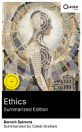
About this ebook
Ethics unfolds in the austere geometrical method—definitions, axioms, propositions, scholia—deriving a monistic metaphysics where God or Nature (Deus sive Natura) is the one substance, of which thought and extension are known attributes. From this basis Spinoza deduces mind–body parallelism, strict determinism, and a naturalistic psychology of the affects, mapping a path from bondage to freedom that culminates in the intellectual love of God. Composed amid seventeenth‐century rationalism and in dialogue with Descartes and scholasticism, the work fuses metaphysics, epistemology, and ethics into a single science of flourishing. Born to Portuguese‐Jewish refugees in Amsterdam, Spinoza (1632–1677) was excommunicated in 1656, a rupture that enabled an independent life supported by lens‐grinding within the relatively free Dutch Republic. His correspondence and early writings show a critical engagement with Cartesian method and biblical hermeneutics; the Ethics, completed late and published posthumously in 1677, distills these projects into a system intended as therapy of the passions as much as demonstration. For readers seeking an architectonic vision of nature and a lucid guide to resilient living, the Ethics is indispensable. It rewards patient study across metaphysics, moral psychology, and theology, illuminating contemporary debates on freedom, emotion, and mind–body relations with austere, hard‐won clarity. Quickie Classics summarizes timeless works with precision, preserving the author's voice and keeping the prose clear, fast, and readable—distilled, never diluted. Enriched Edition extras: Introduction · Synopsis · Historical Context · Author Biography · Brief Analysis · 4 Reflection Q&As · Editorial Footnotes.
Ethics unfolds in the austere geometrical method—definitions, axioms, propositions, scholia—deriving a monistic metaphysics where God or Nature (Deus sive Natura) is the one substance, of which thought and extension are known attributes. From this basis Spinoza deduces mind–body parallelism, stri...
About the author
Baruch Spinoza (1632–1677) was a prominent Dutch philosopher and along with René Descartes, he was a leading philosophical figure of the Dutch Golden Age. By laying the groundwork for the 18th-century Enlightenment and modern biblical criticism, including modern conceptions of the self and the universe, Spinoza came to be considered one of the great rationalists of 17th-century philosophy.
Baruch Spinoza (1632–1677) was a prominent Dutch philosopher and along with René Descartes, he was a leading philosophical figure of the Dutch Golden Age. By laying the groundwork for the 18th-century Enlightenment and modern biblical criticism, including modern conceptions of the self and the un...
Rate this ebook
Tell us what you think.
Reading information
Smartphones and tablets
Install the Google Play Books app for Android and iPad/iPhone. It syncs automatically with your account and allows you to read online or offline wherever you are.
Laptops and computers
You can listen to audiobooks purchased on Google Play using your computer's web browser.
eReaders and other devices
To read on e-ink devices like Kobo eReaders, you'll need to download a file and transfer it to your device. Follow the detailed Help Center instructions to transfer the files to supported eReaders.