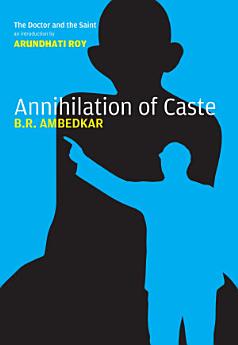
Annihilation of Caste: The Annotated Critical Edition
Oct 2014 · Verso Books
star
3 reviews
Ebook
416
Pages
Tools
info
family_home
Eligible
info
About this ebook
“What the Communist Manifesto is to the capitalist world, Annihilation of Caste is to India.” —Anand Teltumbde, author of The Persistence of Caste
The classic work of Indian Dalit politics, reframed with an extensive introduction by Arundathi Roy
B.R. Ambedkar’s Annihilation of Caste is one of the most important, yet neglected, works of political writing from India. Written in 1936, it is an audacious denunciation of Hinduism and its caste system. Ambedkar – a figure like W.E.B. Du Bois – offers a scholarly critique of Hindu scriptures, scriptures that sanction a rigidly hierarchical and iniquitous social system. The world’s best-known Hindu, Mahatma Gandhi, responded publicly to the provocation. The hatchet was never buried.
Arundhati Roy introduces this extensively annotated edition of Annihilation of Caste in “The Doctor and the Saint,” examining the persistence of caste in modern India, and how the conflict between Ambedkar and Gandhi continues to resonate. Roy takes us to the beginning of Gandhi’s political career in South Africa, where his views on race, caste and imperialism were shaped. She tracks Ambedkar’s emergence as a major political figure in the national movement, and shows how his scholarship and intelligence illuminated a political struggle beset by sectarianism and obscurantism. Roy breathes new life into Ambedkar’s anti-caste utopia, and says that without a Dalit revolution, India will continue to be hobbled by systemic inequality.
“What the Communist Manifesto is to the capitalist world, Annihilation of Caste is to India.” —Anand Teltumbde, author of The Persistence of Caste
The classic work of Indian Dalit politics, reframed with an extensive introduction by Arundathi Roy
B.R. Ambedkar’s Annihilation of Caste is one of ...
Discover more
Ratings and reviews
3 reviews

Nilesh Raut
- Flag inappropriate
December 3, 2015
When/how did Roy become an author here? Read her editorial to the book. Doesn't do justice. She likely did not even read the book, let alone understand it. Please don't but this one, instead buy the original one. Like many others, Navyana also backstabbed Babasaheb.

Venkat Karun
- Flag inappropriate
June 21, 2015
Democracy hasn't eradicated the caste system but has entrenched and modernized it. This seminal work is critical in an epoch where caste has been force-fitted into reductive marxist class analysis. अन्त्यज (Antyaja Sanskrit), the last born outside the pale of Hindu society; the "Untouchables", have been banished from the collective conscious of my generation through selective erasure and deliberate acts of unseeing and this book is critical for those wishing to develop a holistic view. Babasahed Ambedkar -- now reduced to a Ghetto king stripped away of his radical intellect -- wrote "Annihilation of Caste" in 1936 for the Hindu reformist group, the Jat-Pat Today Mandal (forum for breakup of case). Thanks to apathy and nonchalance, the keynote address was was never delivered. This inexcusable ambivalence was highlighted by Gandhi expounding scavenging faeces as a religious duty. Arundhati Roy's biting commentary does more justice and covers this in detail in the introduction. Ambedkar talks at length about the genesis of caste and I found one quote particularly pertinent: "The Purusha Sukta is a later interpolation in the Rig Veda. Verses in the form of questions about the division of Purusha and the origins of the Varnas are a fraudulent emendation of the original." The chapters on pollution and purity were critical for understanding the need for affirmative action. For example, the Nayádis (literally dog-eaters) of Malabar, the lowest class of Hindus in Kerala would contaminate a Brahmin (the highest class in Hindu society) at a distance of 300 feet. This denial of entitlement of land, wealth, knowledge and equal opportunity due to pollution rules defines the genetic blueprint of Hindu society and any change requires perspective.
About the author
Bhimrao Ramji Ambedkar was born in 1891 into an “Untouchable” family of modest means. One of India’s most radical thinkers, he transformed the social and political landscape in the struggle against British colonialism. He was a prolific writer who oversaw the drafting of the Indian Constitution and served as India’s first Law Minister. In 1935, he publicly declared that though he was born a Hindu, he would not die as one. Ambedkar eventually embraced Buddhism, a few months before his death in 1956.
Arundhati Roy is the author of the Booker Prize–winning novel The God of Small Things. Her recent political writings include Listening to Grasshoppers, Broken Republic, and Capitalism: A Ghost Story.
S. Anand is the publisher of Navayana, an independent press in New Delhi. He is the coauthor of Ambedkar: The Fight for Justice, a graphic biography, and has annotated this edition of Annihilation of Caste.
Bhimrao Ramji Ambedkar was born in 1891 into an “Untouchable” family of modest means. One of India’s most radical thinkers, he transformed the social and political landscape in the struggle against British colonialism. He was a prolific writer who oversaw the drafting of the Indian Constitution a...
Rate this ebook
Tell us what you think.
Reading information
Smartphones and tablets
Install the Google Play Books app for Android and iPad/iPhone. It syncs automatically with your account and allows you to read online or offline wherever you are.
Laptops and computers
You can listen to audiobooks purchased on Google Play using your computer's web browser.
eReaders and other devices
To read on e-ink devices like Kobo eReaders, you'll need to download a file and transfer it to your device. Follow the detailed Help Center instructions to transfer the files to supported eReaders.