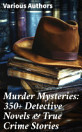
Murder Mysteries: 350+ Detective Novels & True Crime Stories: Sherlock Holmes, Hercule Poirot Cases, P. C. Lee Tales, Father Brown Stories, Dr. Thorndyke Series...
Arthur Conan Doyle · Ernest Bramah · Arthur Morrison · Agatha Christie · Wilkie Collins · Thomas W. Hanshew · Edgar Wallace · Frank Froest · J. S. Fletcher · C. N. Williamson · A. M. Williamson · R. Austin Freeman · E. W. Hornung · G. K. Chesterton · H. C. McNeile · Victor L. Whitechurch · Rober Barr · Isabel Ostander
Dec 2023 · DigiCat
Ebook
22968
Pages
family_home
Eligible
info
About this ebook
Embark on an enthralling journey into the world of crime and deduction with 'Murder Mysteries: 350+ Detective Novels & True Crime Stories.' This anthology is a masterfully curated collection encompassing a wide array of literary styles, from Sherlockian intricacies to locked-room conundrums and psychological thrillers. It stands as a testament to the rich tapestry of detective fiction and true crime narratives, blending classical whodunits with the hard-boiled edge of later eras. Within its pages, readers will discover stories that challenge perceptions and evoke curiosity, while maintaining a pulse on the ever-evolving elements of suspense and intrigue. The contributory voices in this collection hail from an esteemed assembly of literary figures, whose synergy forms the bedrock of crime fiction's storied history. Arthur Conan Doyle, Agatha Christie, and Wilkie Collins spearhead a canon that has influenced countless readers and writers alike. Complemented by the incisive contributions of Bramah, Morrison, and Freeman, the anthology also delves into the cultural zeitgeist of their time, portraying the fears and fascinations of different periods. These authors, alongside their contemporaries, provide a panoramic view of crime narrative evolution, marking pivotal shifts in style and thematic exploration. 'Murder Mysteries: 350+ Detective Novels & True Crime Stories' promises a riveting expedition through an expansive landscape of criminal investigation literature. This collection presents an exceptional chance to engage with multifaceted narratives and to appreciate the varied voices that define detective fiction. It not only caters to enthusiasts of the genre but also serves as a rich resource for scholars and casual readers seeking insight into the cultural dynamics of crime storytelling. Embrace this anthology for its educational value and its ability to cultivate a deeper understanding of the detective genre's profound legacy.
Embark on an enthralling journey into the world of crime and deduction with 'Murder Mysteries: 350+ Detective Novels & True Crime Stories.' This anthology is a masterfully curated collection encompassing a wide array of literary styles, from Sherlockian intricacies to locked-room conundrums and p...
Discover more
About the author
Sir Arthur Conan Doyle (1859–1930) stands as one of the most renowned and influential writers of the late 19th and early 20th centuries, celebrated mainly for his creation of the iconic detective, Sherlock Holmes. Born in Edinburgh, Scotland, Doyle pursued a medical degree at the University of Edinburgh, where he was inspired by Dr. Joseph Bell's deductive approach to diagnosis – an influence that would later shape his literary work. Doyle's oeuvre spans across genres including adventure, science fiction, and historical novels; however, it is the Sherlock Holmes series that solidified his place in the annals of literary history. Notably, the compendium 'Murder Mysteries: 350+ Detective Novels & True Crime Stories' showcases a collection embodying Doyle's exceptional narrative style, which is marked by meticulous plotting, invigorating suspense, and logical rigor. His literary style reflects his medical training, with a precise, clinical approach to unraveling mysteries. Despite his aspiration to be recognized for his historical writings, Doyle's legacy endures through the enduring appeal of Holmes and the profound impact on the detective genre. Doyle was also knighted in 1902, not for his contribution to literature, but for his work during the Boer War, which reflects the breadth of his interests and his sense of duty towards his country. The canon of Sherlock Holmes, with its intricate puzzles and timeless appeal, continues to captivate readers, inspire adaptations, and influence detective fiction to this day.
Sir Arthur Conan Doyle (1859–1930) stands as one of the most renowned and influential writers of the late 19th and early 20th centuries, celebrated mainly for his creation of the iconic detective, Sherlock Holmes. Born in Edinburgh, Scotland, Doyle pursued a medical degree at the University of Ed...
Rate this ebook
Tell us what you think.
Reading information
Smartphones and tablets
Install the Google Play Books app for Android and iPad/iPhone. It syncs automatically with your account and allows you to read online or offline wherever you are.
Laptops and computers
You can listen to audiobooks purchased on Google Play using your computer's web browser.
eReaders and other devices
To read on e-ink devices like Kobo eReaders, you'll need to download a file and transfer it to your device. Follow the detailed Help Center instructions to transfer the files to supported eReaders.