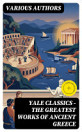
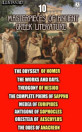
Yale Classics - Ancient Greek Literature: Enriched edition. Mythology, History, Philosophy, Poetry, Theater (Including Biographies of Authors and Critical Study of Each Work)
Aristotle · Plato · Euripides · Gilbert Murray · Epictetus · Theocritus · Homer · Plutarch · Aeschylus · Sophocles · Aristophanes · Herodotus · Anacreon · Sappho · Thucydides · Hesiod · Demosthenes · Lysias · Alcaeus · Archilochus · Theognis of Megara · Simonides of Ceos · Bacchylides · Apollonius · Callimachus
Jun 2022 · DigiCat
Ebook
4462
Pages
family_home
Eligible
info
About this ebook
Yale Classics - Ancient Greek Literature gathers an illustrious ensemble of works that encapsulate the essence of early Western thought, storytelling, and rhetoric. Spanning a multitude of genres, from the epics of Homer to the pointed tragedies of Sophocles and the satirical comedies of Aristophanes, this anthology showcases the vast spectrum of literary artforms fashioned by the ancient Greeks. Within these pages, one encounters the moral inquiries of Epictetus, the lyrical beauty of Sappho, and the philosophical dialogues of Plato, each piece contributing to a mosaic of intellectual and artistic exploration that underpins the whole of Western literary tradition. The collection is enriched by the diverse backgrounds and philosophies of its contributors, including the historiographical insights of Herodotus and Thucydides, the theatrical grandeur of Aeschylus and Euripides, and the rhetorical prowess of Demosthenes. Aligned with the cultural and philosophical shifts of the ancient world, these authors offer a profound commentary on human experience, fate, and the divine. This anthology reflects the dynamism of Greek literary movements, from the epic poetry of Hesiod and Theocritus to the more intimate reflections of the lyric poets, forming a comprehensive tapestry of Hellenic thought and creativity. Yale Classics - Ancient Greek Literature is a testament to the enduring legacy of its contributors, offering readers an unparalleled opportunity to traverse the depth and diversity of ancient Greek literary genius. By exploring these multifaceted texts, readers expand their understanding of the ancient world's sociocultural and philosophical landscape. This anthology is invaluable to both casual readers and scholars, promising a rich compendium of insights that encourages an ongoing dialogue about the enduring themes of human experience across time and culture. In this enriched edition, we have carefully created added value for your reading experience: - An Introduction draws the threads together, discussing why these diverse authors and texts belong in one collection. - Historical Context explores the cultural and intellectual currents that shaped these works, offering insight into the shared (or contrasting) eras that influenced each writer. - A combined Synopsis (Selection) briefly outlines the key plots or arguments of the included pieces, helping readers grasp the anthology's overall scope without giving away essential twists. - A collective Analysis highlights common themes, stylistic variations, and significant crossovers in tone and technique, tying together writers from different backgrounds. - Reflection questions encourage readers to compare the different voices and perspectives within the collection, fostering a richer understanding of the overarching conversation.
Yale Classics - Ancient Greek Literature gathers an illustrious ensemble of works that encapsulate the essence of early Western thought, storytelling, and rhetoric. Spanning a multitude of genres, from the epics of Homer to the pointed tragedies of Sophocles and the satirical comedies of Aristoph...
About the author
Aristotle (384–322 BCE), the prolific ancient Greek philosopher and polymath, was a towering figure in the development of Western thought and science. A student of Plato and the tutor to Alexander the Great, Aristotle's intellectual endeavors spanned various disciplines including metaphysics, ethics, logic, biology, and politics. Central to his philosophy was the pursuit of knowledge, which he classified into practical, theoretical, and productive. In his seminal works such as 'Nicomachean Ethics', 'Metaphysics', 'Politics', and 'Poetics', Aristotle laid the foundation for numerous fields of study and established principles that remain influential to this day. His approach to understanding the world was empirical, emphasizing observation and experience over Plato's idealism. Aristotle's contributions to logic, with his syllogistic method, continue to underpin modern deductive reasoning. In literary theory, his 'Poetics' provides an early treatise on the nature of poetry and drama, crucial to the development of later literary criticism. The corpus of Aristotle's texts, such as those compiled in 'Yale Classics – Ancient Greek Literature', reflects the breadth of his scholarly pursuit, and his works remain essential reading in philosophy, ethics, and the sciences. Although some of his scientific theories were eventually superseded, his logical and philosophical frameworks have endured, affirming his status as one of the founding figures of Western philosophy.
Aristotle (384–322 BCE), the prolific ancient Greek philosopher and polymath, was a towering figure in the development of Western thought and science. A student of Plato and the tutor to Alexander the Great, Aristotle's intellectual endeavors spanned various disciplines including metaphysics, eth...
Rate this ebook
Tell us what you think.
Reading information
Smartphones and tablets
Install the Google Play Books app for Android and iPad/iPhone. It syncs automatically with your account and allows you to read online or offline wherever you are.
Laptops and computers
You can listen to audiobooks purchased on Google Play using your computer's web browser.
eReaders and other devices
To read on e-ink devices like Kobo eReaders, you'll need to download a file and transfer it to your device. Follow the detailed Help Center instructions to transfer the files to supported eReaders.