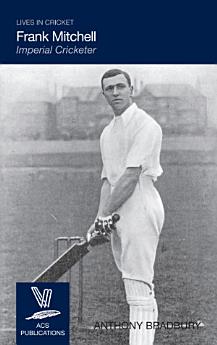
Frank Mitchell: Imperial Cricketer
About this ebook
Cricket, though, was a more lasting interest. Mitchell achieved some notoriety through his actions as captain of Cambridge in the Varsity match of 1896, when he sought to avoid the Oxford XI having to follow-on by instructing his bowler to bowl no balls and wides. His earlier attacking style had already brought him, as a Yorkshireman, to the attention of Lord Hawke, with much of his limited first-class cricket then being played for Yorkshire. Hawke gave him a place on his tour to South Africa in 1898/99, which made Mitchell, retrospectively, an English Test cricketer. He served with the army during part of the Boer War and, after a wonderful season back with Yorkshire in 1901, he emigrated to South Africa.
Working for Abe Bailey, the South African entrepreneur, led Mitchell to captain the South African team to England in 1904 which, though playing no official tests, had a successful tour. Thereafter he worked as a stockbroker, but a surprise recall as captain of the South African team for the triangular tour of 1912 caused more controversy.
Without much personal income, Mitchell struggled with the requirements of amateurism, but he again joined the army in 1914, rising to the rank of lieutenant-colonel. Later he made a living from the precarious tin industry in Nigeria and from writing frequent columns for the cricketer. Some of the aspirations expressed in his articles would remain welcome today. Frank Mitchell was a man of many parts, whose contributions to English and South African sport made him for short periods a notable hero.
Discover more
Ratings and reviews
About the author
Anthony Bradbury was born in Goole, Yorkshire, in 1941. His recollection of early days in Yorkshire is slim for his family moved to Kent in the late 1940s and all his initial interest in cricket arose in southern England. Nevertheless his cricketing hero was and has remained Len Hutton and the only team that he has unswervingly supported at all times has been Yorkshire CCC. He is a past Chairman of the Yorkshire CCC Southern Group and has written regularly for the Yorkshire Yearbook.
He has also written a short history of Early London County Courts, and Reverend ES Carter: A Yorkshire Cricketing Cleric (ACS: Lives in Cricket 51).