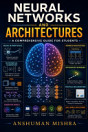
Neural Networks and architectures: A comprehensive guide for students
About this ebook
Introduces sequential data modeling and advanced architectures like LSTM and GRU for handling long-term dependencies.
Chapter 7: Autoencoders and Generative Models 221-241
Contents:
7.1 Introduction to Autoencoders
7.2 Variational Autoencoders (VAE)
7.3 Denoising and Sparse Autoencoders
7.4 Generative Adversarial Networks (GANs)
7.5 Applications in Data Generation, Compression, and Anomaly Detection
Purpose:
Focuses on unsupervised learning, dimensionality reduction, and data generation techniques.
Chapter 8: Advanced Neural Network Architectures 242-274
Contents:
8.1 Deep Belief Networks (DBNs)
8.2 Residual Networks (ResNet) and DenseNet
8.3 Transformer Architecture
8.4 Attention Mechanism and Self-Attention
8.5 BERT, GPT, and Modern NLP Architectures
Purpose:
Covers state-of-the-art architectures in deep learning for both vision and language tasks.
Chapter 9: Optimization Techniques 275-298
Contents:
9.1 Gradient Descent Variants (SGD, Momentum, Adam)
9.2 Learning Rate Scheduling
9.3 Weight Initialization
9.4 Batch Normalization
9.5 Tips for Faster Convergence
Purpose:
Teaches students how to efficiently train deep networks and avoid common pitfalls.
Chapter 10: Practical Implementation 299-340
Contents:
10.1 Python Libraries: TensorFlow, PyTorch, Keras
10.2 Building Neural Networks from Scratch
10.3 Hands-on Projects: MNIST, CIFAR-10, Sentiment Analysis
10.4 Visualizing Neural Network Outputs
10.5 Evaluating Model Performance
Purpose:
Provides practical skills for students to implement and test neural networks themselves.
Chapter 11: Challenges and Future Directions 341-367
Contents:
11.1 Limitations of Neural Networks
11.2 Ethical Concerns and Bias in AI
11.3 Explainable AI (XAI)
11.4 Neuromorphic Computing and Brain-Inspired AI
11.5 Emerging Trends in Neural Network Research
Purpose:
Encourages students to think critically about the impact and future potential of neural networks.
Preface
Artificial Intelligence (AI) has emerged as one of the most transformative and revolutionary fields in modern science and technology. From self-driving cars to intelligent personal assistants, from predictive healthcare systems to advanced financial analytics, AI has permeated nearly every aspect of contemporary human life. Among the numerous paradigms and approaches that constitute AI, neural networks stand out as a cornerstone technology that has not only enabled remarkable breakthroughs but also inspired a new generation of machine learning methodologies. The purpose of this book, “Neural Networks and Architectures”, is to provide a comprehensive, clear, and methodically structured guide for students who aspire to understand, design, and implement neural networks in practical and research-oriented settings.
Neural networks, inspired by the biological neural structures of the human brain, represent a class of models that are particularly adept at capturing complex patterns, recognizing high-dimensional data relationships, and generalizing from examples to unseen scenarios. Over the past decade, with the advent of increased computational power, the proliferation of data, and the development of sophisticated algorithms, neural networks have transitioned from theoretical constructs to real-world implementations, revolutionizing fields such as computer vision, natural language processing, robotics, and even creative arts. This book is designed to serve as a bridge for students, connecting the foundational principles of neural networks to cutting-edge architectures and applications in modern AI systems.
Introduction to the Book
The journey of understanding neural networks begins with recognizing their historical significance and biological inspiration. Neural networks, in their simplest form, are computational models that mimic the structure and function of neurons in the human brain. Each artificial neuron receives input signals, processes them using weighted connections, and produces an output based on a specific activation function. This basic principle of computation underlies all neural architectures, whether simple feedforward networks or complex transformer-based models.
This book is structured to provide students with a gradual learning curve. It begins with fundamental concepts, including the mathematics and computational principles essential for understanding neural networks, and gradually moves toward advanced architectures such as Convolutional Neural Networks (CNNs), Recurrent Neural Networks (RNNs), Autoencoders, Generative Adversarial Networks (GANs), and Transformer-based models like BERT and GPT. The goal is to equip learners with both theoretical understanding and practical implementation skills, allowing them to confidently approach real-world AI problems.
Throughout this book, emphasis has been placed on clarity, practicality, and accessibility. Each chapter begins with conceptual explanations, followed by mathematical formulations, intuitive illustrations, and practical examples. Code snippets, especially in Python using frameworks such as TensorFlow and PyTorch, are provided to reinforce understanding and encourage hands-on experimentation. Exercises, mini-projects, and case studies are incorporated to enhance problem-solving skills and to encourage students to apply what they have learned to real datasets.
Importance of Neural Networks in Modern AI
Neural networks have become a central pillar of modern AI due to their ability to model complex, nonlinear relationships in data, learn directly from raw input, and generalize to previously unseen scenarios. Unlike traditional machine learning algorithms that often require manual feature extraction and domain-specific knowledge, neural networks excel at automatic feature learning, enabling them to perform exceptionally well in domains such as image recognition, speech synthesis, natural language understanding, and autonomous systems.
1. Applications in Computer Vision
One of the most prominent success stories of neural networks is in the domain of computer vision. Tasks such as object detection, facial recognition, and medical image analysis have witnessed unprecedented improvements due to the deployment of Convolutional Neural Networks (CNNs). For instance, CNN architectures such as AlexNet, VGG, ResNet, and DenseNet have achieved remarkable accuracy in image classification competitions, surpassing human-level performance in some scenarios. These models are now widely used in industrial applications, including autonomous vehicles, security surveillance, and diagnostic imaging in healthcare.
2. Applications in Natural Language Processing (NLP)
Neural networks have also revolutionized the field of natural language processing. Recurrent Neural Networks (RNNs), Long Short-Term Memory (LSTM) networks, and Gated Recurrent Units (GRUs) enable machines to understand, interpret, and generate human language by modeling sequential dependencies in textual data. More recently, transformer-based architectures such as BERT, GPT, and T5 have further advanced NLP capabilities, powering applications like chatbots, sentiment analysis, machine translation, and question-answering systems. These advancements have transformed the way humans interact with machines, creating more natural, intelligent, and responsive AI systems.
3. Generative Modeling and Creativity
Generative models, including Variational Autoencoders (VAEs) and Generative Adversarial Networks (GANs), have demonstrated the ability of neural networks to create new data that closely resembles real-world patterns. GANs, for instance, can generate realistic images, videos, and even music, enabling AI systems to assist in creative industries such as art, entertainment, and design. The generative capabilities of neural networks open up new frontiers in AI, demonstrating their versatility and creative potential.
4. Impact Across Industries
The impact of neural networks extends far beyond academic research. In healthcare, neural networks aid in diagnosing diseases, predicting patient outcomes, and personalizing treatment plans. In finance, they are employed for fraud detection, algorithmic trading, and credit scoring. In transportation, neural networks optimize route planning and enhance autonomous vehicle navigation. In marketing, they improve customer segmentation, recommendation systems, and demand forecasting. The widespread adoption of neural networks in various industries underscores their importance as a fundamental technology in modern AI.
How the Book is Structured for Learning
The design of this book follows a logical and incremental approach to learning, ensuring that students build a solid foundation before tackling complex topics. The book is divided into multiple chapters, each addressing a specific aspect of neural networks, progressing from basic concepts to advanced architectures. The structure is intentionally student-centric, incorporating explanations, illustrations, code examples, and practical exercises.
1. Foundational Chapters: The initial chapters introduce the fundamental concepts, including the biological inspiration behind neural networks, the mathematical foundations necessary for understanding their computations, and the basic architectures such as single-layer and multi-layer perceptrons. These chapters ensure that students are comfortable with the core principles before moving to more advanced topics.
2. Intermediate Chapters: Subsequent chapters cover essential topics such as activation functions, regularization techniques, and optimization methods. These chapters equip students with practical skills required to design, train, and fine-tune neural networks effectively.
3. Advanced Architectures: Later chapters delve into specialized architectures like CNNs, RNNs, Autoencoders, GANs, and Transformers. Each architecture is explained in detail, covering both the theoretical underpinnings and practical implementations, supplemented with case studies and real-world applications.
4. Practical Implementation: The book emphasizes hands-on learning by including Python-based tutorials, code examples, and exercises using popular libraries such as TensorFlow, Keras, and PyTorch. Students are encouraged to experiment with datasets such as MNIST, CIFAR-10, and IMDB reviews to reinforce their understanding and gain confidence in building neural networks from scratch.
5. Exercises and Projects: Each chapter concludes with exercises and mini-projects designed to test comprehension, enhance problem-solving skills, and provide practical exposure. These exercises range from implementing simple feedforward networks to developing complex deep learning models for image recognition or text analysis.
6. Future Perspectives: The final chapters discuss cutting-edge research, ethical considerations, and emerging trends in neural network architectures, enabling students to appreciate the broader context of AI research and prepare for future developments in the field.
Target Audience
This book has been meticulously designed to cater to a broad audience, including undergraduate and graduate students, researchers, and beginners who aspire to develop expertise in neural networks and AI.
1. Undergraduate Students: The book provides foundational knowledge, mathematical background, and practical skills suitable for computer science, data science, and engineering students. It serves as both a textbook and a reference guide for coursework and projects.
2. Graduate Students: For graduate-level learners, the book covers advanced architectures, optimization techniques, and research-oriented perspectives, making it a valuable resource for thesis work, research projects, and academic exploration.
3. Beginners in AI and Machine Learning: The book assumes minimal prior knowledge of neural networks and gradually introduces concepts in an accessible manner. Step-by-step explanations, intuitive illustrations, and code examples ensure that beginners can follow along and gain practical skills.
4. Industry Professionals and Enthusiasts: Professionals seeking to upskill in AI and machine learning can also benefit from this book, as it combines theoretical rigor with practical implementation, preparing readers to tackle real-world problems and build AI-powered solutions.
Learning Outcomes
By the end of this book, readers are expected to achieve the following learning outcomes:
1. Comprehension of Fundamental Concepts: Understand the biological inspiration, historical evolution, and core principles of neural networks.
2. Mathematical and Computational Proficiency: Acquire proficiency in linear algebra, calculus, probability, and statistics, which are essential for neural network computations.
3. Design and Implementation Skills: Develop the ability to design, implement, and train various neural network architectures, including MLPs, CNNs, RNNs, Autoencoders, GANs, and Transformers.
4. Optimization and Fine-Tuning: Gain knowledge of optimization techniques, regularization methods, and hyperparameter tuning to improve model performance and generalization.
5. Application-Oriented Learning: Apply neural network techniques to real-world problems in computer vision, natural language processing, time-series forecasting, and generative modeling.
6. Practical Programming Skills: Acquire hands-on experience using Python and deep learning libraries such as TensorFlow, Keras, and PyTorch.
7. Critical Thinking and Research Awareness: Develop the ability to critically analyze neural network models, understand their limitations, and explore future research directions in AI.
8. Project Development Capability: Build complete end-to-end AI projects, from data preprocessing to model deployment, reinforcing the integration of theoretical knowledge and practical skills.
9. Ethical and Responsible AI Awareness: Understand the ethical implications, potential biases, and societal impacts of neural networks, fostering responsible AI practices.