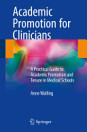
Academic Promotion for Clinicians: A Practical Guide to Promotion and Tenure in Medical Schools, Edition 2
About this ebook
The biggest change for the new edition is the incorporation of the growing literature and many recent developments regarding career development and promotion for non-tenure track faculty including new chapters addressing the specific concerns of the largest groups, clinician-educators and those heavily involved in research or patient care. Since the previous edition, the faculty of US medical schools has grown by 25% to over 200,000 individuals, 75% of whom are physicians. Only 21% of faculty members have achieved professorial rank. This book aims to encourage interest in academic promotion and provide practical assistance to the 96,000 assistant professors and 42,000 associate professors in US medical schools. Women and members of groups historically underrepresented in medicine (URM) face unique issues in navigating academic promotion systems. These issues have received greater attention from institutions and in the literature since the first edition. The revision includes a summary of national and institutional efforts to make academic careers and promotion more desirable and feasible for women and faculty members from URM and other disadvantaged backgrounds, including discussion of outcomes and future directions for such programs.
The sections on faculty perceptions and attitudes towards promotion have also been heavily revised to include consideration of the influence of important events and trends since the previous edition such as the COVID pandemic, transition of the last cohort of baby boomers into retirement age groups, and developments in literature on professional identity and career motivation. The update also addresses the influence of the growing “feminization of medicine” on academic careers. Since 2013, the number of female faculty members has risen from 61,000 (38% of total) to 85,000 (44%). Currently, 59% of instructors, 48% of assistant professors, and 41% of associate professors are women. The accelerating “flight from tenure” in clinical departments is also addressed. Updated data and graphs demonstrate the dramatic changes in tenure-related appointments of clinicians and the substantial differences across specialties. In 2023 only 19% of fulltime clinical faculty hold tenure-related appointments but this ranged from around 11% in family medicine to over 33% in public health and preventive medicine. The new edition expands the discussion of the implications of these trends on expectations for career development, and on the criteria and systems for academic promotion for clinicians.
Finally, the book provides updated information on external and internal changes in the medical school environment that impact faculty careers and academic promotion. These include significant revision of the process and requirements for LCME accreditation; the demands and consequence of the “medical education revolution” and widespread curricular reforms; growing significance of team science, translational, applied and other non-traditional research; financial and other pressures on academic health centers; the continuing blurring of the distinctions between academic and other clinical institutions; and initiatives to recruit and retain non-traditional faculty members, especially the “preceptor crisis” of competition among health professional schools for community-based volunteer faculty members and clinical teaching sites.
The second edition of Academic Promotion for Clinicians is a valuable resource for clinical faculty members as they engage in and navigate the challenges of the APT process.
Discover more
Ratings and reviews

- Flag inappropriate
About the author
Anne Walling, MB, ChB
Professor Emerita
University of Kansas School of Medicine
Wichita, KS, USA