About this ebook
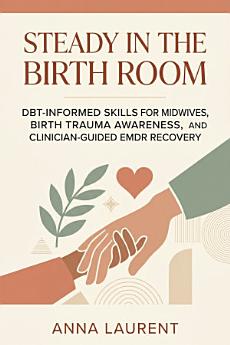
Steady in the Birth Room
DBT-Informed Skills for Midwives, Birth Trauma Awareness, and Clinician-Guided EMDR Recovery
By Anna Laurent
Birth work asks you to stay calm in rooms that are not calm.
A labor stretches deep into the night. A family needs answers you do not yet have. A clinical turn changes the plan in seconds. You make the call, finish the handover, go home, and discover that one moment from the shift has followed you through the door.
Steady in the Birth Room is a practical guide for midwives who want useful emotional skills without being told to simply “be resilient.” It translates DBT skills for midwives into short, realistic practices for attention, distress tolerance, emotion regulation, communication, validation, and professional boundaries. The goal is not perfect calm. The goal is to think clearly, act within scope, communicate well, and know when a difficult experience needs more support than a coping technique can provide.
For the long labor, the hard handover, and the birth you cannot stop replaying
Many books on professional wellbeing stay abstract. This one begins where the work actually happens: in the room, during the pause between changes, in the conversation that has become tense, and later at home when your body is off shift but your mind has not received the memo.
You will learn practical mindfulness for labor that does not require closing your eyes, leaving the room, or pretending urgency is peaceful. The book shows how to separate observation from interpretation, use precise language when stress is escalating, work with radical acceptance without drifting into resignation, and make clear requests when a team needs to act.
It also addresses midwife burnout prevention without reducing burnout to bubble baths and better time management. Personal recovery matters, but so do workload, staffing, autonomy, recognition, supervision, and leadership. The book keeps those levels separate so individual skills do not become an excuse for structural problems.
A clear, careful approach to birth trauma
Difficult births can affect parents and professionals in different ways. Some experiences settle with time, sleep, explanation, and ordinary support. Others leave intrusive memories, avoidance, panic, nightmares, guilt, numbness, hypervigilance, or a loss of professional confidence.
The section on birth trauma recovery explains what trauma-related symptoms can look like, when a parent or clinician may need assessment, and how respectful communication can reduce avoidable confusion and powerlessness during care. It also covers vicarious trauma for midwives, secondary traumatic stress, moral distress, and the limits of informal peer support.
The language stays careful. The book does not diagnose every upsetting birth as PTSD, and it does not ask midwives to become therapists for their patients or colleagues.
EMDR explained without turning it into a DIY protocol
If you have searched for EMDR for birth trauma, you have probably found everything from qualified clinical information to videos promising rapid self-treatment. This book draws a firm line between understanding EMDR and trying to administer it to yourself.
You will get a plain-language explanation of EMDR’s eight-phase treatment structure, what a trained therapist may assess before reprocessing begins, how preparation and closure fit into treatment, and what questions to ask when choosing a clinician. The book does not teach readers to target traumatic memories, perform bilateral-stimulation sets, or conduct self-directed desensitization.
That distinction matters. EMDR is psychotherapy. Knowing what treatment involves can help you make informed choices without turning the reader into an unlicensed provider.
Steady in the Birth Room
DBT-Informed Skills for Midwives, Birth Trauma Awareness, and Clinician-Guided EMDR Recovery
By Anna Laurent
Birth work asks you to stay calm in rooms that are not calm.
A labor stretches deep into the night. A family needs answers you do not yet have. A clinical turn cha...
Discover more
Rate this ebook
Tell us what you think.
Reading information
Smartphones and tablets
Install the Google Play Books app for Android and iPad/iPhone. It syncs automatically with your account and allows you to read online or offline wherever you are.
Laptops and computers
You can listen to audiobooks purchased on Google Play using your computer's web browser.
eReaders and other devices
To read on e-ink devices like Kobo eReaders, you'll need to download a file and transfer it to your device. Follow the detailed Help Center instructions to transfer the files to supported eReaders.