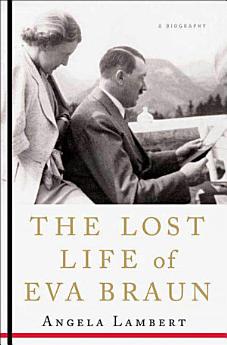
The Lost Life of Eva Braun: A Biography
About this ebook
Eva Braun has been dismissed as a racist, feathered-headed shop girl, yet sixty-two years after her death her name is still instantly recognizable.
She left her convent school at the age of seventeen and met Hitler a few months later. How did unsophisticated little Fraulein Braun, twenty-three years his junior, hold the most powerful man in Europe in an exclusive sexual relationship that lasted from 1932 until their joint suicide?
Braun's private diary and photograph albums show that her life with Hitler caused her emotional torture. His chauffeur called her "the unhappiest woman in Germany." The Führer humiliated her in public. Yet Albert Speer said: "She has been much maligned. She was very shy, modest. A man's woman: gay, gentle, and kind; incredibly undemanding . . . And her love for Hitler—as she proved in the end—was beyond question."
Angela Lambert reveals a woman the world never knew until the last twenty-four hours of her life. In the small hours of April 29, 1945, as Allied troops raced to capture Berlin and the bunker below the Reichskanzlei where the defeated Nazi leaders were hiding, Eva Braun finally achieved her life's ambition by becoming Hitler's wife. Next day they both swallowed cyanide and died instantly. Based on detailed new research, this is an authoritative biography, only the second life of Eva written in English.
"A fascinating read." — Booklist
"A remarkable, fully developed portrait of a woman who happened to share her life with one of the most hated men in history." — Tucson Citizen
Discover more
Ratings and reviews

- Flag inappropriate
- Show review history
About the author
Angela Lambert was born to a German mother and an English father and grew up bilingual. From 1947–50 she lived in Germany and met her surviving German relatives for the first time, though they never talked about their experiences in wartime Hamburg. She read philosophy, politics, and economics at St. Hilda's College, Oxford and worked as a civil servant, journalist, and TV reporter until 1998. Her first book, Unquiet Souls: The Indian Summer of the British Aristocracy, 1880–1918, was one of three shortlisted for the 1986 Whitbread Prize. This is her tenth book and first biography.