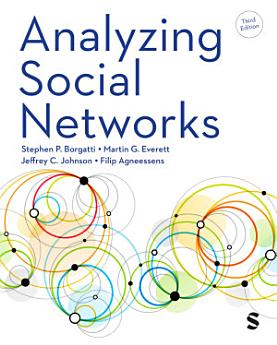
Analyzing Social Networks: Edition 3
ഈ ഇ-ബുക്കിനെക്കുറിച്ച്
Supporting you step-by-step through the entire research process, from design and data collection to coding, visualisation, and analysis, the book also offers:
• Case studies and examples using real data
• Exercises drawn from the authors’ decades of teaching experience
• Online access to datasets, worked examples and a software manual to help you practice your skills.
Whether you are new to social network analysis or an experienced researcher, this approachable book is your technical toolbox and research companion all in one.
രചയിതാവിനെ കുറിച്ച്
Stephen P. Borgatti, PhD is the Gatton Endowed Chair of Management at the Gatton College of Business and Economics at the University of Kentucky. He has published extensively in management journals, as well as cross-disciplinary journals such as Science and Social Networks. He has published over 100 peer-reviewed articles on network analysis, garnering more than 80,000 Google Scholar citations. With Martin Everett, Steve is co-author of UCINET, a well-known software package for social network analysis, as well as founder of the annual LINKS Center workshop on social network analysis. He is also a two-term past president of INSNA (the professional association for network researchers) and winner of their Simmel Award for lifetime achievement.
Martin Everett is Professor of Social Network Analysis and co-director of the Mitchell Centre for SNA at the University of Manchester. He has published extensively on social network analysis and has over 100 peer-reviewed articles and consulted with government agencies as well as public and private companies. With Stephen Borgatti, Martin is co-author of UCINET, a well-known software package for social network analysis and is co-editor of the journal Social Networks. He is also a past President of INSNA (the professional association for network researchers) and winner of their Simmel Award for lifetime achievement. He was elected as an academician to the UK Academy of Social Sciences in 2004.
Jeffrey C. Johnson, PhD is University Term Professor of Anthropology at the University of Florida. He is a former program manager with the Army Research Office (IPA), where he started the basic science research program in the social sciences. He has conducted extensive long-term research, supported by the National Science Foundation, comparing group dynamics and the evolution of social networks of over-wintering crews at the American South Pole Station with those at the Polish, Russian, Chinese, and Indian Antarctic Stations. In related research, he has studied aspects of team cognition and social networks on success in simulated space missions. He is a winner of INSNA’s Simmel Award for lifetime achievement. He has published extensively in anthropological, sociological, biological, aerospace, and marine science journals and was the founding editor of the Journal of Quantitative Anthropology, co-editor of the journal Human Organization, and is the author of Selecting Ethnographic Informants (Sage, 1990).
Filip Agneessens is an Associate Professor at the Department of Sociology and Social Research, University of Trento. He has published on a diversity of topics related to social networks, including measures of centrality, statistical models, ego-networks and social support, two-mode networks, negative ties, multilevel networks and issues related to data collection. He has also applied social network analysis to understand the antecedents and consequences of interactions among employees, and in particular within teams. Together with Martin Everett, he was a guest-editor for a special issue on “Advances in Two-mode Social Network Analysis” in the journal Social Networks, and together with Nick Harrigan and Joe Labianca he guest-edited a special issue on “Negative and Signed Tie Networks”. He has taught numerous introductory and advanced social network courses and workshops over the last 15 years.