About this ebook
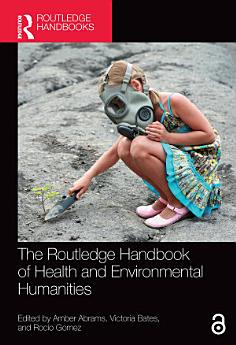
The handbook captures the dynamism of the cross-disciplinary dialogue between these fields through a unique approach. It blends the elements of a traditional handbook with novel interventions. The collection features academic pieces across three sections – Concepts; Methods; and Case studies. Each of these sections also includes short provocations and contributions from artists, practitioners, and activists in these fields, interspersed with "conversation" pieces.
The handbook will be a valuable resource for scholars in health humanities, medical humanities, and environmental humanities, as well as related disciplines such as history, literary studies, philosophy, anthropology, and geography.
Chapter 18, 30 and 34 of this book are freely available as a downloadable Open Access PDF at Home | Taylor & Francis eBooks, Reference Works and Collections under a Creative Commons Attribution (CC BY) 4.0 International license.
Discover more
About the author
Amber Abrams is Senior Research Officer at the Future Water research institute at the University of Cape Town. Abrams has over 25 years of experience working in academia, for government and the private sector in the fields of public health, research science at the intersection of humans and environment, and in social sciences and social engagement translating research science for publics.
Victoria Bates is Associate Professor at the University of Bristol. She has led or collaborated on several health-and-environment projects, including the "MedEnv" network and the project "A Sense of Place: Exploring nature and wellbeing through the non-visual senses". She had a UKRI Future Leaders Fellowship for "Sensing Spaces of Healthcare: Rethinking the NHS Hospital".
Rocío Gomez is Associate Professor and Greer Chair of Latin American History at Virginia Commonwealth University. Her first book, Silver Veins, Dusty Lungs: Mining, Water, and Public Health in Zacatecas, 1835–1946 (2020) received the Melville Prize for Best Book in Latin American Environmental History from CLAH.