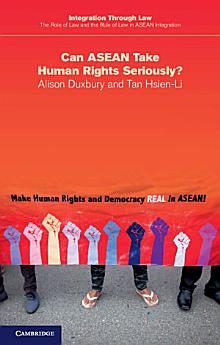
Can ASEAN Take Human Rights Seriously?

·
· Cambridge University Press
Ebook

About this ebook

The adoption of the ASEAN Charter in 2007 represented a watershed moment in the organisation's history - for the first time the member states explicitly included principles of human rights and democracy in a binding regional agreement. Since then, developments in the region have included the creation of the ASEAN Intergovernmental Commission on Human Rights in 2009 and the adoption of the ASEAN Human Rights Declaration in 2012. Despite these advances, many commentators ask whether ASEAN can take human rights seriously. The authors explore this question by comprehensively examining the new ASEAN human rights mechanisms in the context of existing national and international human rights institutions. This book places these regional mechanisms and commitments to human rights within the framework of the political and legal development of ASEAN and its member states and considers the way in which ASEAN could strengthen its new institutions to better promote and protect human rights.
The adoption of the ASEAN Charter in 2007 represented a watershed moment in the organisation's history - for the first time the member states explicitly included principles of human rights and democracy in a binding regional agreement. Since then, developments in the region have included the crea...

About the author

Alison Duxbury is a Professor at Melbourne Law School, University of Melbourne, and a member of the International Advisory Commission of the Commonwealth Human Rights Initiative and the Council of the Australian and New Zealand Society of International Law. Alison's major research interests are in the fields of international law, international institutional law and human rights law. Her previous publications include The Participation of States in International Organisations: The Role of Human Rights and Democracy (Cambridge, 2011) and a co-edited book, Military Justice in the Modern Age (Cambridge, 2016). Duxbury has been a Visiting Fellow at the Lauterpacht Centre for International Law in Cambridge, the Centre for Comparative and Public Law at the University of Hong Kong, the Oxford Institute for Ethics, Law and Armed Conflict and the Institute of Commonwealth Studies in London.

Tan Hsien-Li is the Co-Director (Teaching) for the ASEAN Law and Policy Programme at the Centre for International Law (CIL) and Assistant Professor at the Faculty of Law, National University of Singapore (NUS). Dr Tan previously held fellowships at the European University Institute, Florence, and the Jean Monnet Center for International and Regional Economic Law and Justice, New York University. She was also the AsianSIL Research Fellow at NUS and the Ushiba Memorial ASEAN Fellow in Tokyo. Dr Tan researches on the role and the rule of law and institutions in ASEAN integration; public international law, particularly on institution building and norm creation; and human rights and peace and security. She wrote the first book on the ASEAN human rights system: The ASEAN Intergovernmental Commission on Human Rights (Cambridge, 2011) and has co-authored a book on ASEAN dispute settlement mechanisms: Promoting Compliance (Cambridge, 2016).

Alison Duxbury is a Professor at Melbourne Law School, University of Melbourne, and a member of the International Advisory Commission of the Commonwealth Human Rights Initiative and the Council of the Australian and New Zealand Society of International Law. Alison's major research interests are i...

Rate this ebook

Tell us what you think.

Reading information

Smartphones and tablets
Install the Google Play Books app for Android and iPad/iPhone. It syncs automatically with your account and allows you to read online or offline wherever you are.
Laptops and computers
You can listen to audiobooks purchased on Google Play using your computer's web browser.
eReaders and other devices
To read on e-ink devices like Kobo eReaders, you'll need to download a file and transfer it to your device. Follow the detailed Help Center instructions to transfer the files to supported eReaders.